Budget
Gala budget template: costs, revenue and the $75 ticket rule
Costs, revenue, net and cost per dollar raised, and what a US charity must tell a guest who pays over $75 for a ticket that is partly a gift.
Alexis · Co-founder of Squena · October 8, 2026 · 16 min read
In short
A gala budget template has two halves: costs by category, and revenue from tickets, tables, sponsors, auctions and gifts. The net is revenue minus committed costs, and costs divided by revenue give the cost per dollar raised. In the United States, a charity that sells a ticket over $75 that is partly a gift must, with a few exceptions, say in writing what the evening is worth. Only the rest is deductible.
In its instructions for Form 990, the IRS describes a dinner where an organization charges $400 per person. The dinner has a retail value of $160. So a guest is really buying a $160 dinner and making a $240 contribution. A charity gala ticket priced above the value of the evening splits the same way, and a useful gala budget template keeps both parts in view.
Search for a gala budget template, and page 1 mixes galleries, paid kits and two very different files. The top result, from Cater+Event (formerly Special Events), is a cost list for its Gala Awards, dated August 7, 2019. Its page says that “Gala Award judges want to be shown the cost to replicate your event”, and it lists costs only. Search for a fundraising gala budget template instead, and software companies that sell to nonprofits, such as Handbid, offer a profit-and-loss sheet, with revenue next to costs.
This guide is for a nonprofit that runs a fundraising gala in the United States: the development team, the event chair or the committee. It covers costs by category, revenue by source, the net, the cost per guest, the cost per dollar raised and the IRS rule on ticket prices. A company gala has the same costs and usually no revenue: fill in the cost half and leave the rest empty.
The file downloads without a form. Fill in the gala at the top of the Budget tab, then the revenue and the expenses below it, and the summary works itself out. How to follow planned, committed and paid spending has its own guide, the event budget template, so it stays short here.

What the gala budget template calculates
The Budget tab reads from top to bottom: the gala and a summary side by side, then a revenue table, then an expenses table. At the top, you enter the gala's name, date and venue, and the expected guests, from 1 to 5,000. Then come the tickets sold, the ticket price and your fundraising goal.
Two more cells serve the quid pro quo check, explained below. Fair market value per guest is your own estimate of what one guest receives for the ticket: dinner, drinks, the show. The quid pro quo threshold starts at 75, the figure in IRS Publication 1771, and you can change it. Amounts carry no currency symbol.
| Summary line | How the file works it out | When it stays empty or changes color |
|---|---|---|
| Expenses, estimated / committed / paid | Totals of the Estimated, Committed (signed) and Paid columns | Always shown; a dash (zero) to start |
| In-kind value (kept apart) | Total of the In-kind column, left out of every other figure | Always shown; a dash (zero) to start |
| Revenue, goal / actual | Totals of the Goal and Actual columns of the revenue table | Always shown; a dash (zero) to start |
| Net (actual revenue minus committed) | Actual revenue minus committed expenses | Empty until some revenue is entered, so a company gala with no revenue never turns red; red below zero |
| Cost per guest | Committed expenses ÷ expected guests | Empty without guests or a committed amount |
| Cost per dollar raised | Committed expenses ÷ actual revenue | Empty without actual revenue or a committed amount |
| Actual revenue ÷ fundraising goal | Share of the goal at the top raised so far | Empty without a goal or actual revenue |
| Deductible portion per ticket (at most) | At most the ticket price minus fair market value, never below zero | Empty until both are entered |
| Quid pro quo check | Shows “Enter the threshold”, “Enter the fair market value” or “Written disclosure may be needed” | Amber in all three cases. The first when a price is entered and the threshold is empty; the second when the price is above the threshold and the value is empty; the third when the price is above the threshold and the value is above zero and below the price. Empty otherwise |
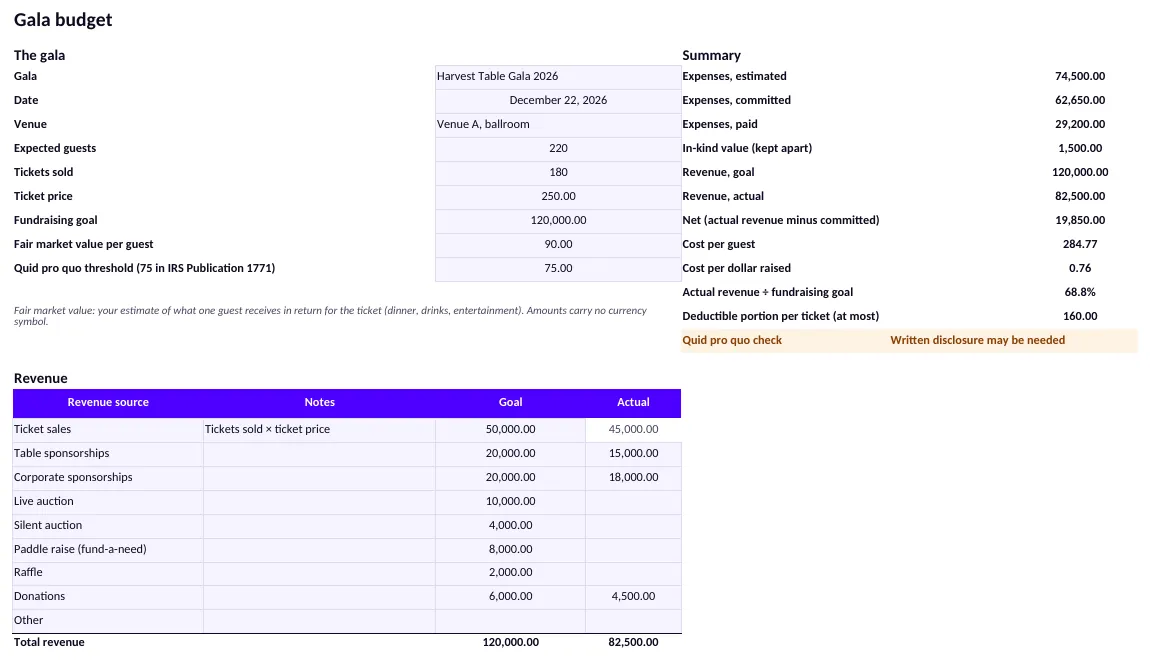
In the preview, the made-up gala has 62,650 committed and 82,500 raised so far, which leaves a net of 19,850. Its cost per dollar raised is 0.76: each dollar has cost 76 cents to raise. The auction and paddle raise lines have no actual yet, so both figures will still move.
The cost side: estimated, committed, paid
Each expense row takes a category, a line item, a vendor, four amounts and a variance. The category comes from a list of 14 kept in column J, or you type your own: the cell warns you, and lets you keep it. The file starts with one line item per category, such as Venue rental, Dinner or Bar service, and ten empty rows below them.
| Category | Starting line item |
|---|---|
| Venue | Venue rental |
| Catering | Dinner |
| Beverages | Bar service |
| Decor and florals | Centerpieces and room decor |
| Production (AV, lighting, staging) | Sound, lighting and staging |
| Entertainment | Host, band or DJ |
| Auction and raffle | Auction items bought and raffle prizes |
| Printing and invitations | Invitations, programs and signage |
| Photo and video | Photographer |
| Staffing and security | Event staff |
| Transportation and valet | Valet or shuttles |
| Permits, licenses and insurance | Event insurance and permits |
| Software and payment fees | Ticketing, bidding and card fees |
| Contingency | Contingency |
Estimated is your plan, Committed is the signed amount, and Paid is what has gone out. Variance is committed minus estimated. It stays empty until you enter a committed amount, then turns red above zero, when the signed price is over your estimate.
That is the short version of the method. Why committed matters more than paid, and how to track invoices once quotes are signed, is the subject of the event budget template guide.
In-kind is the value of what someone gives instead of money, such as donated wine or an auction prize. The sheet keeps it apart: it stays out of the estimated, committed and paid totals, and out of the net. A gift is not a saving you can spend.
Some lines are easy to forget. Handbid's guide, written by its CEO, tells planners to budget for a raffle license if the raffle needs one, for an alcohol permit if serving requires it, and for event insurance.
The revenue side: tickets, tables, sponsors, auctions and gifts
The revenue table has nine sources: ticket sales, table sponsorships, corporate sponsorships, live auction, silent auction, paddle raise (fund-a-need), raffle, donations and other. Each takes a goal, set before the gala, and an actual, typed as money comes in. For ticket sales, the actual works itself out: tickets sold times the ticket price. Two goals live in the file. Revenue, goal adds up the goals by source. Actual revenue ÷ fundraising goal compares what has come in with the single goal typed at the top. Keep the two equal, or know why they differ.
A table sold to a company is one payment for several seats. Publication 1771 applies the $75 test to a single payment. What you can take from it: a table is checked as a whole, and its disclosure values every seat it brings. The sheet's check only looks at the ticket price, so check tables yourself.
For an auction, the guest's side is in IRS Publication 526. Its example is a week at a beach house bought for $600 at a charity auction, no more than its fair rental value. The buyer has made no deductible gift. Paying more than the value can count as a gift, but only if the excess is paid with the intent to make a charitable contribution.
The IRS page on charity auctions adds what the buyer must show. A buyer can deduct what they pay above an item's fair market value, but must be able to show they knew the value was lower than the price. The IRS example is a catalog with a good faith estimate for each item. What you can take from it: post the value next to each item.
Publication 1771 never names auctions. What you can take from its $75 rule: a winning bid of more than $75, paid partly as a gift and partly for the item, is a payment like a gala ticket. The charity then owes the buyer a written disclosure.
Net, cost per guest and cost per dollar raised
Net is what the gala leaves for the cause: actual revenue minus committed expenses. The sheet uses committed rather than paid, because a signed quote is money you owe before the invoice arrives. Net stays empty until some revenue is entered, so a company gala with no revenue never shows red.
Cost per guest divides committed expenses by expected guests. Cost per dollar raised divides them by actual revenue: 0.40 would mean 40 cents spent for each dollar that came in.
BBB Wise Giving Alliance, which reviews charities against 20 standards, says a charity “should spend no more than 35 cents to raise a dollar”. The standard sets total fundraising costs against the gifts raised in the past fiscal year, and special event income can count among them. When BBB works from the Form 990, it usually adds total contributions (line 1h) and event income after direct costs (line 8c), where the sheet divides by gross revenue. What you can take from it: it is a yardstick for the whole charity, not a target for one evening.
The AFP Foundation for Philanthropy surveyed its members in the United States and Canada for its 2014 Special Events Report, and 101 of them answered. For galas, “46 percent reported costs of less than $0.59 per dollar raised, and eight percent reported costs of $0.60 or more”. Another 21 percent did not know, and 26 percent did not answer. These are members' own estimates, from a small sample in 2014. What you can take from it: read them as a loose range, and compare a gala with its own past editions first.
The $75 rule: what a charity must tell a gala guest
The rule is federal and American, and it binds the charity rather than the guest. IRS Publication 1771, revised in November 2023, is written for organizations “such as charities and churches” that receive tax-deductible gifts, and for their donors. A domestic 501(c)(3) charity is the Form 990 instructions' example of such an organization. A contribution made in exchange for goods or services is what the IRS calls a quid pro quo contribution.
When a guest pays more than $75, partly as a gift and partly for goods or services such as a dinner, the charity must give a written disclosure statement. It tells the guest that the deductible part is limited to what they paid above the value of what they got. It also gives a good faith estimate of that value.
Publication 1771 lets the charity give it “in connection with either the solicitation or the receipt” of the payment. It must be in writing and likely to come to the donor's attention: small print inside a longer document might not do. What you can take from it: the ticket page and the receipt are the natural places for it.
The IRS example is a $100 concert ticket worth $40. The deduction cannot exceed $60, and the statement is still required, because the payment is over $75. Separate payments of $75 or less, made at different times of the year for separate fundraising events, are not added together, say the Form 990 instructions.
A charity that fails to give it faces a penalty of $10 per contribution, up to $5,000 per fundraising event or mailing. It avoids the penalty if it can show reasonable cause, says the IRS page on quid pro quo contributions.
| Payment | What the payer receives | Written disclosure required? | Deductible part |
|---|---|---|---|
| $100 (Publication 1771) | A concert ticket valued at $40 | Yes: the payment is over $75 | Up to $60 |
| $400 (Form 990 instructions) | A dinner with a retail value of $160 | Yes: the payment is over $75 | $240 is a contribution |
| $65 (Publication 526) | A dinner dance ticket with a fair market value of $25 | No: the payment is $75 or less | $40 |
| $600 (Publication 526) | A week at a beach house, at no more than its fair rental value | No: no gift in the payment | None |
Pricing the evening, and when no disclosure is needed
The fair market value of the evening
In its guidance on quid pro quo contributions, the IRS lets a charity use “any reasonable method” to value what it gives. The method must be applied in good faith. When the thing is not sold commercially, comparable goods or services will do. In the IRS example, a private event in a museum room is valued at the rent of a comparable hotel ballroom, $2,500.
What you can take from it: price the evening as a guest would pay for a comparable dinner, drinks and show, not from your cost per guest. In the sheet, that number goes in Fair market value per guest. The sheet then shows the deductible portion per ticket: the price minus that value, never below zero. For a ticket the guest keeps, read it as a ceiling, since the donor's own case can lower it. Under the token exception below, or for a ticket returned for resale, the whole payment can be deductible instead.
The quid pro quo check reads Written disclosure may be needed, in amber, when the ticket price is above the threshold and the value is above zero but below the price. If the value is still empty, it asks you to enter it, and it asks for the threshold if you have cleared it. When the value is as high as the price, the ticket holds no gift, and the cell stays empty. The rule only covers a payment made partly as a contribution. Publication 1771's “no donative element” exception, whose example is a museum gift shop sale, points the same way. The token, membership and religious exceptions are not checked.
When no disclosure is needed
- Token benefits, in a fundraising campaign that tells donors how much is deductible. Either the benefit is worth no more than 2% of the payment, capped at $139 in 2026. Or the only items carry your name or logo and cost you $13.90 or less in total, for a payment of at least $69.50.
- Membership benefits: an annual payment of $75 or less that brings only recurring rights, such as free or discounted admission or parking.
- Intangible religious benefits, from a group organized only for religious purposes, such as admission to a religious ceremony.
- No donative element, as in a typical museum gift shop sale.
Publication 1771 prints the 2023 amounts, $125, $62.50 and $12.50, and says they are adjusted for inflation. Revenue Procedure 2025-32 gives the 2026 figures above. What you can take from it: a seated dinner is worth far more than those token amounts, so the token rule rarely covers a gala ticket.
What a gala guest can deduct
For individual donors, Publication 526 (2025) says that a guest who pays more than the value of a charity ball, banquet or show can deduct only the part above that value. The value is the event's established charge, its regular price, when it has one; otherwise, the reasonable value of attending. In the IRS example, a $40 benefit showing of a movie whose regular price is $8 holds a $32 contribution.
Using the ticket or not changes nothing. A guest who returns the ticket to the charity for resale can deduct the whole price. A ticket marked “contribution” is not fully deductible just because of that label, and raffle tickets are not deductible as a charitable contribution.
A gift of $250 or more also needs a contemporaneous written acknowledgment from the charity before the donor can deduct it. When a payment is partly for goods or services, the gift is only the part above their value, Publication 526 adds. What you can take from it: check the gift part of each payment against the $250 line, not its price.
If your nonprofit cannot receive deductible gifts
Some tax-exempt groups, such as business leagues, cannot receive tax-deductible charitable gifts. Section 6113 of the tax code then asks them to say, in every fundraising solicitation, that gifts are not deductible as charitable contributions. The statement must be “express” and “in a conspicuous and easily recognizable format”, says the IRS solicitation notice page. A letter or call outside a campaign that reaches more than 10 people in a year does not count as a solicitation. Notice 88-120, from 1988 and still cited by the IRS, counts solicitations for attendance at fundraising events among those covered. It exempts groups whose annual gross receipts normally stay at $100,000 or less, judged, in general, on a three-year average. A local chapter is not exempt, though, if at least 25 percent of the money it solicits goes to a larger unit above that line.
After the gala: how Form 990 splits the money
If your charity files Form 990, the return splits each ticket the same way. In the $400 dinner example, the $240 gift goes on line 1c as a contribution, and the $160 retail value on line 8a as gross income. The cost of the food, drinks and invitations goes on line 8b.
Schedule G, Part II, applies when fundraising event gross income and contributions add up to more than $15,000, on Form 990 or 990-EZ. It lists each event with gross receipts over $5,000, the two largest in their own columns. Its direct costs are cash prizes, noncash prizes, rent, food and beverages, entertainment, and other costs.
What you can take from it: keep Venue, Catering, Beverages and Entertainment on their own lines, as the sheet does. Three of those Schedule G lines are then easier to fill in from your budget.
Donated auction items need care. In another example from the Form 990 instructions, a donated home theater system worth $5,000 is shown with that value before and during the auction, so bidders know it. It sells for $7,500, with $500 of costs. The $2,500 above its value is a contribution, so the event's gross income counts only $5,000. The $5,000 is also reported as a noncash contribution. It is a direct expense too, with the $500 of costs, so the event's net income line shows a loss of $500. What you can take from it: give your accountant each item's value from the In-kind column, kept apart in the sheet.
A raffle at the gala is gaming for the IRS: its income goes on line 9a, split from the event. A raffle whose prizes have only nominal value is the exception, reported as contributions. Publication 3079, revised in October 2018, adds that state and local laws may require more records and reporting for gaming. It notes that many states and localities regulate gaming by exempt organizations, and leaves their licensing rules aside. What you can take from it: ask the agencies where the gala takes place whether your raffle needs a license.
Where Squena fits
Squena covers three columns of this sheet's cost half: estimated, committed and paid. Each event has a planned budget, and “View breakdown” opens it line by line: Planned, Committed (signed quote), Paid, Left to commit and Left to pay. Spending with no supplier, such as insurance or contingency, gets its own line with “Add a line”.
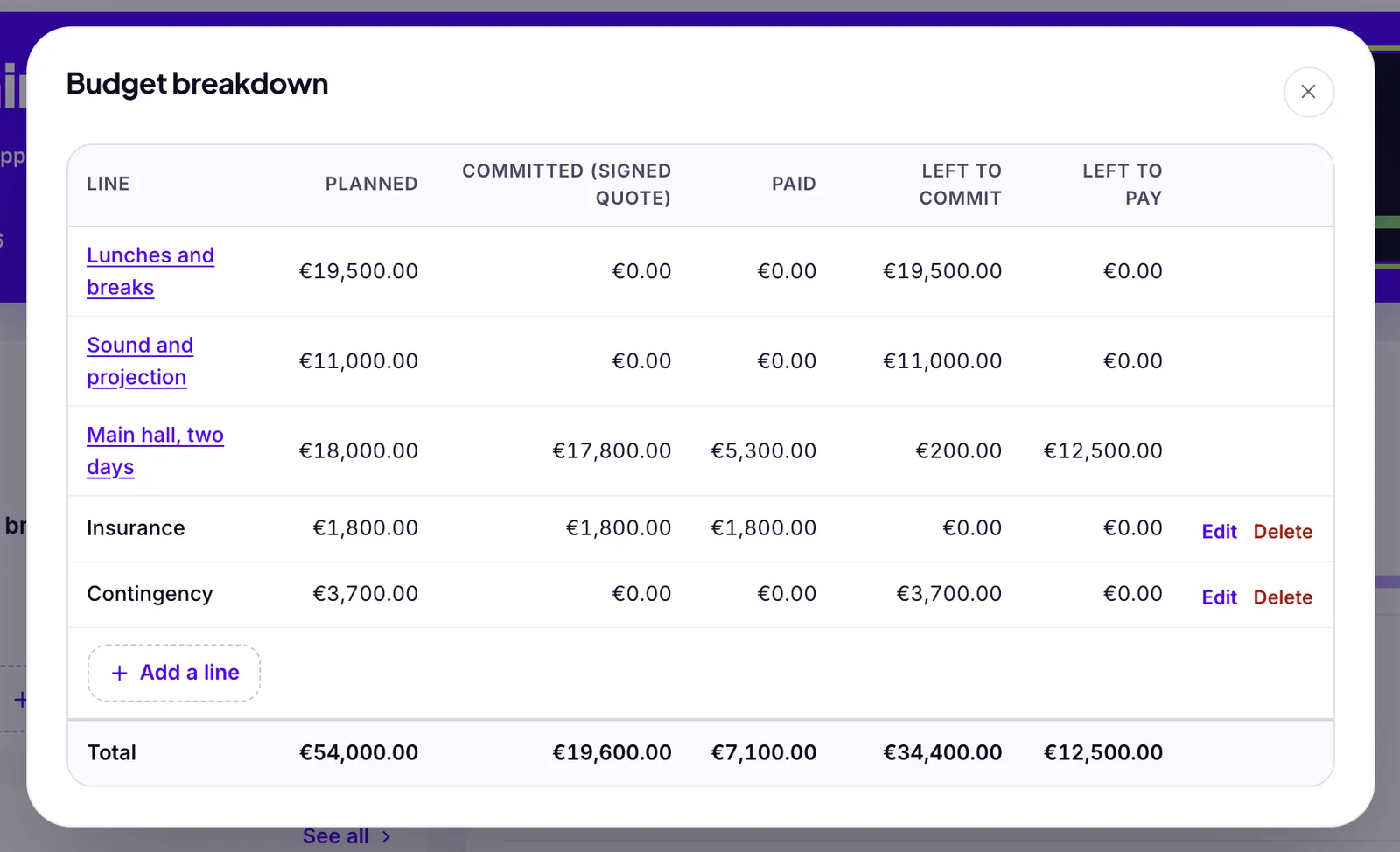
Paid stays a declaration: you enter a deposit, then the balance, as the money goes out. Squena does not track revenue: no ticket sales, tables, sponsorships, auctions, paddle raise or donations, and no fair market value or disclosure. Amounts are in euros, even in English. Keep the revenue half and the tax check in this sheet, and follow the spending in Squena.
Frequently asked questions
What should a gala event budget template include?
Costs by category, with estimated, committed and paid amounts; revenue by source, with a goal and an actual; and a summary with the net, the cost per guest and the cost per dollar raised. For a US charity, add the fair market value of the evening, so you can state the deductible part of each ticket.
How much of a gala ticket is tax-deductible?
In the United States, only the part above the fair market value of what the guest receives, such as dinner and drinks. In an IRS example, a $400 dinner ticket with a retail value of $160 holds a $240 contribution. Using the ticket or not changes nothing, unless the guest returns it to the charity for resale.
When does a charity need a quid pro quo disclosure for a gala ticket?
When a guest pays more than $75, partly as a gift and partly for goods or services such as a dinner, unless an IRS exception applies. The charity must state in writing that only the amount above their value is deductible, and give a good faith estimate of that value. Missing it costs $10 per contribution, up to $5,000 per fundraising event or mailing, unless there is reasonable cause.
What is a good cost per dollar raised for a gala?
There is no rule for a single event. BBB Wise Giving Alliance says a charity should spend no more than 35 cents to raise a dollar, across all its fundraising in a fiscal year. In a 2014 AFP Foundation survey of 101 members, 46 percent put a gala's typical cost below $0.59 per dollar raised and 8 percent at $0.60 or more; the rest did not know or did not answer. Compare a gala with its own past editions first.
Are raffle tickets and auction purchases at a gala deductible?
Raffle tickets are not deductible as a charitable contribution, according to IRS Publication 526. An auction purchase can be deductible only for the part paid above the item's fair market value, paid with the intent to give: in the IRS example, a week at a beach house bought at its fair rental value holds no deductible gift.
Sources
- Publication 1771, Charitable Contributions: Substantiation and Disclosure Requirements (Rev. 11-2023) — Internal Revenue Service (US)
- Charitable Contributions: Quid Pro Quo Contributions (page reviewed June 28, 2026) — Internal Revenue Service (US)
- Publication 526, Charitable Contributions (2025), for donors — Internal Revenue Service (US)
- Revenue Procedure 2025-32, section 4.33: insubstantial benefit amounts for 2026 — Internal Revenue Service (US)
- Instructions for Form 990 (2025): lines 1c, 8a to 8c and 9a, and the quid pro quo disclosure — Internal Revenue Service (US)
- Instructions for Schedule G (Form 990) (12/2024): Part II, fundraising events — Internal Revenue Service (US)
- Solicitation notice: section 6113, nonprofits that cannot receive deductible gifts — Internal Revenue Service (US)
- Notice 88-120: section 6113 safe harbors and the $100,000 gross receipts exception — Internal Revenue Service (US)
- Charity auctions (page reviewed June 28, 2026) — Internal Revenue Service (US)
- Publication 3079, Tax-Exempt Organizations and Gaming (Rev. 10-2018) — Internal Revenue Service (US)
- BBB Standards for Charity Accountability, standard 9: fund raising expenses — BBB Wise Giving Alliance
- 2014 Special Events Report: U.S. and Canada (54-page PDF; table 2, cost per dollar raised by event type; 101 respondents; funded in part by the StubHub Foundation) — AFP Foundation for Philanthropy
- Gala Budget Template, written for Gala Awards entrants (August 7, 2019) — Cater+Event (formerly Special Events)
- Free Fundraising Event Budget Template + Steps to Follow (undated; a bidding software company) — Handbid