Suppliers
How to negotiate with event vendors: levers, limits and the deposit
Set your target and your walk-away price, trade instead of haggling, and settle the deposit and balance dates before you sign.
Alexis · Co-founder of Squena · October 8, 2026 · 15 min read
In short
To negotiate with event vendors, decide before the first call what you want to pay and the price at which you walk away. Then trade what each side values, such as dates, volume, scope and how fast you pay, instead of only asking for a discount. Settle the deposit, the balance date and what happens to the deposit if either side cancels, and write every concession down.
Among the first results for how to negotiate with event vendors are tip lists from a ticketing platform, an event technology company and a speaker booking agency. This guide adds two things. One is the method behind the tips, taken from published negotiation guides. The other is the payment side: the deposit, the balance, and what happens to the deposit if the deal ends.
It is written for the organizer who buys: a company, an association or an agency holding quotes from a venue, a caterer or an AV crew. Comparing those quotes comes first, and our guide to comparing vendor quotes covers it. Here you negotiate with your top choice, and the other quotes are your alternative. The word vendor can also mean a seller who rents a stall at a market, which is another negotiation. Couples planning a wedding will find the method useful, but the examples are not written for them. Most examples come from the United States. Two of the tip lists above come from a Canadian agency and a Spanish company, and the two British sources, on safety and on late payment, are labeled as such. None of it is legal advice.
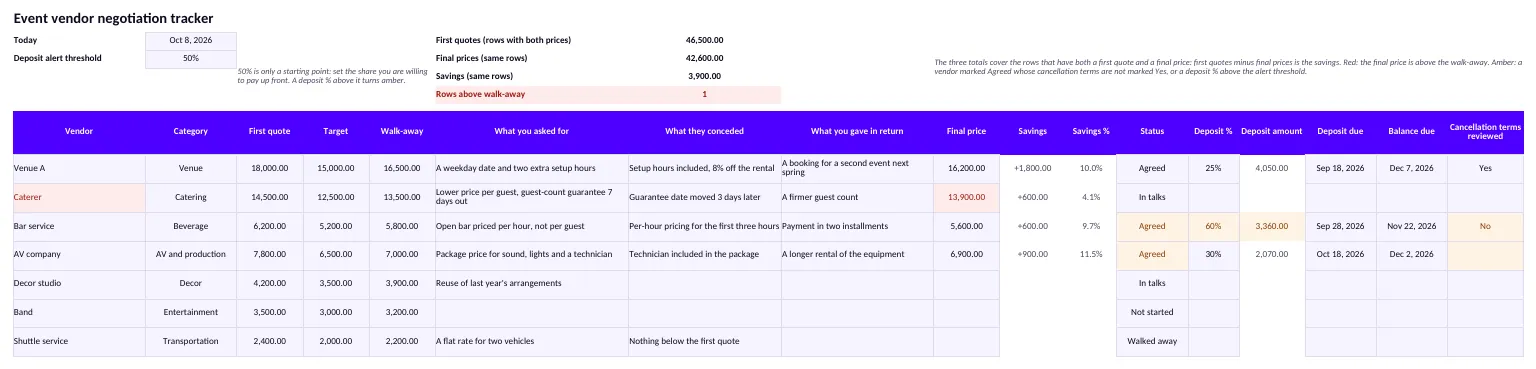
The file downloads without a form. Type each vendor's first quote, your target and your walk-away price. Then log what you asked for, what they conceded and what you gave back. The deposit and the balance dates sit in the same row.

Set your target and your walk-away price first
Negotiation is easier when you know your numbers before the first call. The State of Arkansas's procurement office published a negotiation guide for its buyers in 2023. It lists "The desired best price and the highest acceptable price" among the minimum contents of a negotiation plan. The state's rules then required such a plan before some bids were negotiated. The office's 2026 rules say an agency may develop one. Either way, it binds state buyers, not you.
What you can take from it: those two numbers are your target and your walk-away price. Write them down before you talk. In the tracker they sit next to the vendor's first quote, and a final price above your walk-away turns the vendor name and the final price red.
Harvard Law School's Program on Negotiation explains the BATNA, your best alternative to a negotiated agreement. In plain terms, it is "what you will do if you do not reach a deal," as the Program puts it. It says the BATNA tells you whether to accept an offer, how much leverage you bring, and when it makes sense to walk away. Its example is a home insurance policy priced 30% lower that covered less once the fine print was read. What you can take from it: bring a competing quote to the same scope before you count it as your alternative.
What you can negotiate, and what you cannot
Before you ask, check that the vendor controls the item. Talent Bureau, a speaker booking agency, gives this list in a 2025 article.
Setup and delivery fees, minimum spend requirements, room access hours, and value-adds like signage placement or equipment swaps are typically negotiable. Staffing costs, particularly unionized labour, hard material costs, taxes, and third-party vendor rates usually aren't.
Talent Bureau, Top Tips on Negotiating with Vendors, August 25, 2025
That is one agency's experience, not a rule, so use it as a list of questions. It also hints at what a vendor can give easily. PCMA's Convene magazine reported in 2018, in what it called a seller's market, on how association planners negotiate with hotels. Kendra Allman of the National Stone, Sand, and Gravel Association said a venue finds it easier to give you something when the cost to itself is low. Convene's example: airport pickups for top speakers are simple if the hotel runs its own car service, and harder if it must hire one. It adds that Dawn Amaskane of the American Osteopathic Association asks in the RFP who manages AV, parking and internet, to learn what costs the venue little.
If a vendor will not lower the price, ask for more at the same price. Arkansas's guide says best value may include "added value in a contract at the original contract price," for example enhanced services at no extra cost. Eventbrite's examples are complimentary setup and takedown, extra staff for high-traffic areas, and longer service hours.
Some items are not concessions at all. In Great Britain, the Health and Safety Executive says an organizer has "prime responsibility" for the health and safety of workers, the public and contractors at the event. The same page asks contractors a question: can they confirm they have "sufficient resources to do the work safely"? What you can take from it: do not accept a discount that depends on a contractor cutting safety staff, equipment or cover. U.S. rules differ and are outside this guide.
Levers: date, volume, commitment and speed of payment
A vendor prices its calendar, its crew and its cash flow. Each one gives you something to ask for, or to offer. The tracker's second sheet, What to ask, lists sixteen starting points to raise with a venue, a caterer or an AV company, from service charge to force majeure. Delete what does not apply.
| Lever | What to ask or offer | What a source says |
|---|---|---|
| Date and day of the week | Ask whether another date suits the vendor better | Talent Bureau: events in shoulder seasons, on weekdays or in slow periods give vendors more margin, and they often pass some along when asked directly. |
| Volume and length | A rate for consecutive days or several dates | Forsyth Conference Center, a Georgia college facility, gives 15% off consecutive full-day rentals or advance bookings of over three full days. |
| Bundling | One vendor for AV and staging, or for catering and linens | Talent Bureau: bundling gives the vendor more total margin, so you can ask for upgrades or value-adds instead of straight discounts. |
| Future business | A rate held for next year, or priority booking | Talent Bureau: vendors who enjoy working with an organizer offer deals and priority bookings that they do not extend to one-time clients. |
| Speed of payment, size and term | A lower price for paying sooner, a larger order or a longer contract | Harvard's Program on Negotiation: "a lower per-unit price in exchange for faster payment, a longer contract, or a larger order size." |
A date can be worth more than a haggle. Convene's 2018 article tells of the American Physiological Society and a Virginia resort. The resort quoted a room rate of $350 for the society's June 2019 meeting, and the society said no. The resort called back and asked about flexibility in timing. It offered a Thursday-to-Saturday stretch it needed to fill, at $150, plus a $10 resort fee. The society's RFPs said dates were preferred but flexible, and its staff now ask hotel salespeople whether a better date means a better price.
A published price list shows that the day of the week alone can change the price. The Forsyth Conference Center belongs to Lanier Technical College, a unit of the Technical College System of Georgia. Its rate sheet, updated in March 2025, lists a full-day rate for the whole conference center of $3,500 on weekdays and $4,500 on weekends. That is about 29% more. This is one venue's price list, not a market rate.
Timing also matters inside the deal. Talent Bureau says the closer you are to the event, or the more publicly you have announced a vendor, the less leverage you have. Convene's reporter advised negotiating at the end of the year, because salespeople have quotas and quotas have deadlines. Arkansas's guide gives the other side: do not give the vendor a negotiation deadline of your own, because it will cost you leverage.
Trade instead of asking for a discount
Harvard's Program on Negotiation says most negotiations involve several issues, so both sides can expand the pool of value through trade-offs. Trading works when each side gives up what it values less. The Program advises you to negotiate the issues together: agree that nothing is final until everything is agreed, then propose packages instead of isolated demands. Convene gives the event version. It reports Margaret Ann Neale, a Stanford business school professor, advising you to match things unimportant to you with what is very important to them, and the reverse.
Decide what you would trade before you sit down. Arkansas's guide has buyers sort items into "must have," "want to have" and "nice to have." It then asks which nice-to-have terms they would give up to secure the must-haves. It also says to ask what cost or value is tied to a sticking point.
Should you share your budget? Talent Bureau suggests asking what the vendor would recommend within your budget. Lisa Gates, a negotiation coach, told Convene to be open about the budget and what you want, then let the vendor think it over. Harvard's guide says you should never reveal your bottom line. What you can take from it: share a budget and what you want, and keep your walk-away price in your sheet.
| To do this | A question from the sources | Who says it |
|---|---|---|
| Open on budget | "Here's our budget; what would you recommend within that?" | Talent Bureau, a speaker booking agency |
| Trade across items | "If we invest here, where can we save elsewhere?" | Talent Bureau, a speaker booking agency |
| Ask for a better date | "Can we move to a better date for a better price? Does your schedule have a hole to fill?" | The society's staff in the Convene story |
| Understand a demand | "Can you help me understand why you need that much time?" | Harvard's Program on Negotiation, about a long closing period |
The tracker keeps each trade in three columns: What you asked for, What they conceded and What you gave in return. Savings is the first quote minus the final price, and Savings % is that gap as a share of the first quote.
Payment terms and the deposit
Price is one number. Payment terms decide when money leaves your account, and what you lose if the plan changes. Settle five points in the same conversation, before you sign.
- The deposit: how much, and by what date.
- What the deposit covers, and whether it counts toward the final bill.
- The rest: the balance date, the invoice terms and how you pay.
- What happens to the deposit if you cancel.
- What happens to the deposit if the vendor cancels.
Points four and five belong to the cancellation clause, which our guide to the event cancellation clause reads line by line. This guide stays with the deposit itself.
What two published schedules look like
Some public venues publish their terms, which makes them handy examples. Each of these describes its own bookings, and neither is a standard.
| Facility | Deposit | Balance |
|---|---|---|
| Forsyth Conference Center, Lanier Technical College (Georgia) | 50 percent of the room rental to secure the reservation; at least 20 percent of it is non-refundable, and the refund shrinks as the event date nears | The remaining 50 percent is due seven business days before the event (the guidelines' fees section and the rate sheet say five) |
| University of Montana, Conference and Event Services (summer programs) | 50% of total, due upon signing of the agreement | Due within 30 days of receiving the final invoice, which is sent about two weeks after the event |
Both ask for half at signing, and they differ on the rest. The Georgia college collects the balance before the event, and the Montana office collects it after. The Georgia guidelines add three details worth turning into questions. A booking made less than 30 days out needs 100 percent of the rental rate to hold the space. Georgia state agencies with a purchase order get credit terms of 30 days. And in unforeseen circumstances, if either the facility or the client cancels, the return of the deposit is at the director's discretion. What you can take from it: terms depend on who pays and on who cancels, so ask.
Read a vendor's documents against each other. Forsyth's March 2025 rate sheet asks for a $1,000 security deposit for social events, paid with the final payment five business days before the event. Its guidelines, last modified in September 2024, ask for $500 five days before the event, plus $1,000 more for some events. They also give two balance dates: seven business days before the event in the payment terms, and five in the fees section. What you can take from it: when documents from one vendor disagree, ask which one your contract uses, and have the number and the date written into it.
The tracker turns the Deposit % and Deposit amount cells amber above a threshold you set at the top of the sheet. It starts at 50%, which is a starting point and not a standard. Two schedules are only two examples. Change the threshold to the share you are willing to pay up front.
The balance: dates, interest and the UK rule
Put a date on the balance, and say what happens if you pay late. In the UK, GOV.UK says that a payment date you agree must usually be within 30 days for public authorities or 60 days for business transactions. A period longer than 60 days must be fair to both businesses. If you agree no date, the payment is late 30 days after the customer gets the invoice, or after the service is delivered if that is later. Between businesses, statutory interest is 8% plus the Bank of England base rate, but it cannot be claimed if the contract sets a different rate.
That guide covers payments between businesses in the UK. This article cites no equivalent rule for a U.S. vendor, so write the balance date, the interest for late payment and the invoice terms into the contract.
In the tracker, each vendor's row holds Deposit %, the deposit amount calculated from the final price, Deposit due, Balance due and a Yes or No for Cancellation terms reviewed. If a vendor is marked Agreed without that Yes, the Status and Cancellation cells turn amber. Once you sign, our event vendor list template tracks what is due and what is paid.
Put each concession in writing
A concession you only heard is not yet a term. Eventbrite advises following a conversation with an email that summarizes what was discussed, then making sure those terms are added to the contract. The Forsyth guidelines go further. They say that no verbal agreements for the use of the Conference Center shall be valid.
Arkansas's guide shows how a state buyer records a price cut. An email in which the vendor agrees to the lower cost serves as documentation. For a price sheet with many lines, the guide says to ask for a revised sheet that shows the lowered costs. Eventbrite adds two asks worth copying: an itemized breakdown of all charges upfront, and your approval of any unexpected charge before it reaches the final bill. In the tracker, enter as Final price the price in the document you sign, not the one you were promised on the phone.
Know when to stop
Your walk-away price is also your stopping rule. Harvard's guide says your alternative tells you when it makes sense to walk away. Gates told Convene that some requests will be refused, and that you can set the point aside and come back to it. The resort in the American Physiological Society story had been walked away from, and it called back.
Pushing has a cost, and sources disagree on where it stops. Meetmaps, an event technology company, wrote in 2016 that for a vendor you plan to use again, accepting a reasonable first offer within your budget can build goodwill. It still said it always makes sense to negotiate a venue. Talent Bureau warns that a large discount request without context can leave a resentful vendor who finds other ways to cut corners. Those are two companies' opinions. In the tracker, the Walked away status keeps the vendor on your list. Our guide to comparing vendor quotes covers the signs that justify setting an offer aside before any negotiation.
Where Squena fits
In Squena, each supplier on an event has a stage and three amounts: Quote received, Committed (signed) and Paid. Paid is a declaration you make once the commitment is signed: what has gone out, a deposit first and then the balance. A supplier who answers through the Squena link can add Deposit requested and Deposit due by, and the printed quote shows them. Adjust sends the supplier a new quote request, and the conversation opens on "Could you adjust your quote?" for you to complete. It appears once their quote is in and their record has an email address, and only while no supplier on that need is Approved, Signed or Paid.
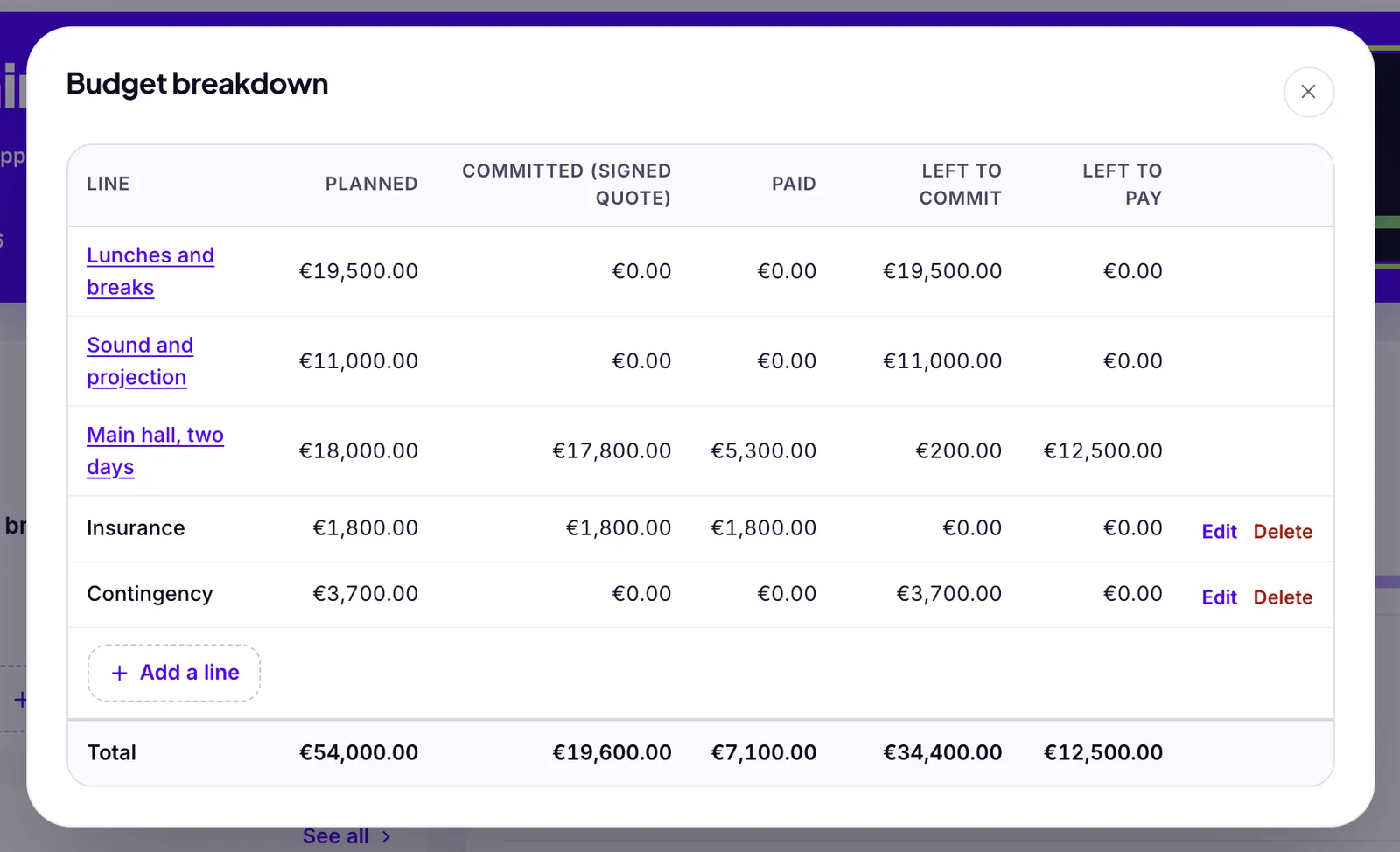
Squena is not a negotiation tool. It has a planned amount per budget line. It has no dedicated field for a walk-away price or for what each side conceded, only a free-text Notes box on each supplier. The screen shows the supplier's latest proposal, not the earlier ones. Add a deposit date as a task: the task list marks it overdue once the date has passed, but sends no alert. Amounts are in euros, even in English. Use the sheet for the talks, then enter the agreed amounts when you sign.
Frequently asked questions
What can you negotiate with an event vendor?
Often the date, setup and delivery fees, minimum spend, access hours, extras such as signage or equipment swaps, and, as a trade, how fast you pay. One speaker agency says staffing, hard material costs, taxes and third-party rates are usually fixed. Check that the vendor controls an item before you push on it.
How much deposit do event vendors ask for?
It varies, and none of the sources in this guide sets a standard. Two published schedules, a Georgia college's conference center and the University of Montana's summer programs, both ask for 50% at signing. In the Georgia one, at least 20 percent of the deposit is non-refundable, and the refund shrinks as the event date nears. Ask for the percentage, the date and the refund terms in writing.
Should I tell a vendor my budget?
Sources split on how much to say. A speaker agency suggests asking what the vendor would recommend within your budget. Harvard's Program on Negotiation says never to reveal your bottom line. A workable middle is to share a budget and what you want, and keep your walk-away price to yourself.
When should I negotiate with an event vendor?
Early, once you hold comparable quotes and before you commit to a vendor or announce one. Talent Bureau says your leverage shrinks as the event date nears and after you announce a vendor. Arkansas's procurement guide adds a tip: do not give the vendor a deadline of your own.
What should I get in writing after a negotiation?
The final price, every concession you won, the deposit amount and date, the balance date, and what happens to the deposit if either side cancels. As Eventbrite advises, follow each call with an email that summarizes what was agreed, then make sure the contract carries the same terms.
Sources
- Negotiation (procurement guide for State of Arkansas buyers; PDF with no letterhead, footer 06072023, read as June 7, 2023; superseded in part by the Office's 2026 rules) — Arkansas Office of State Procurement (Department of Shared Administrative Services; named Transformation and Shared Services in its 2024 documents)
- Procurement Laws and Rules, July 11, 2024 (rule R15, Negotiations, item (e): "The agency must develop a plan to include at least") — Arkansas Department of Transformation and Shared Services, Office of State Procurement
- Procurement rules, 19 CAR Part 1 (PDF created July 21, 2026; § 1-522(a)(5): "The agency may develop a plan to include at least") — Arkansas Office of State Procurement, Department of Shared Administrative Services
- Late commercial payments: charging interest and debt recovery (UK, business to business) — GOV.UK
- Late commercial payments: interest on late commercial payments (UK, business to business) — GOV.UK
- Are you a...? (HSE event safety guidance; page updated March 16, 2023; Great Britain) — Health and Safety Executive (Great Britain)
- Forsyth Conference Center standard room rental rates (updated March 2025) — Lanier Technical College, a unit of the Technical College System of Georgia
- Forsyth Conference Center Guidelines (PDF linked from the center's Room Information page; undated, file last modified September 10, 2024) — Lanier Technical College, a unit of the Technical College System of Georgia
- Booking Process, summer programs (undated) — University of Montana, Conference and Event Services
- What is BATNA? How to Find Your Best Alternative to a Negotiated Agreement (Guhan Subramanian, September 30, 2026) — Program on Negotiation, Harvard Law School
- Value Creation in Negotiation (Katie Shonk, July 16, 2026) — Program on Negotiation, Harvard Law School
- How to Negotiate Better With Hotels for Your Events (Ellen Ryan, published October 31, 2018 per the page metadata) — PCMA Convene
- Top Tips on Negotiating with Vendors: Advice from the Event Circuit (August 25, 2025; for context) — Talent Bureau (speaker booking agency)
- The Complete Guide to Negotiating Contracts with Vendors (December 18, 2024; for context) — Eventbrite (ticketing platform)
- 10 Mandatory Rules Before Negotiating With Event Vendors (March 11, 2016; for context) — Meetmaps (event technology company)