Suppliers
Event cancellation clause: what to read before you sign
Who may cancel, what each date costs, what happens to your deposit, and what force majeure really covers, read from the organizer's side.
Alexis · Co-founder of Squena · October 2, 2026 · 14 min read
In short
An event cancellation clause says what you owe a venue or vendor if you call the event off. Before you sign, check who may cancel and how notice is given, the fee for each period before the event, what that percentage is a percentage of, and what happens to your deposit. Force majeure is a separate clause for events outside both parties' control, so read which events it names and what notice it requires.
This guide is for the organizer who reads the cancellation clause of a venue, hotel or vendor contract before signing it. It starts from the United States, where contract rules vary from state to state. It does not cover the refund policy you write for your attendees, or the policy a vendor writes for its own clients. And it is not legal advice.
On April 29, 2019, Amplifi Live, the financial partner of Woodstock 50, announced that it had decided to cancel the festival. A Woodstock 50 representative replied that it vehemently denied the cancellation and would seek a legal remedy. On May 15, a Manhattan judge ruled that Amplifi did not have the right to cancel on its own under its contract. But he did not make Amplifi put $18 million back into the festival, at least for now. The money dispute and other issues were headed to arbitration, the Associated Press reported.
That contract tied a festival to its investor, not to a venue, and these reports do not say what it provided for cancellation. Still, the ruling touched the two questions that any cancellation clause has to answer: who may cancel, and what happens to the money already put in. This guide is about finding those answers in your own contracts, before you sign them.
No form stands between you and the file: download it and fill it in. The Run it in Squena button opens the form for a new event. Squena holds your suppliers, documents and tasks, not this tracker, as the last section explains.

Canceling, force majeure and attrition are not the same exit
Joyce Scardina Becker, an event planner and instructor, separates two clauses in an article for Cater+Event (April 28, 2020). A termination clause covers performance prevented or made impossible, by acts of God, which she also calls force majeure events, or by third parties such as strikes or government orders. The parties can then end the contract without further liability. A cancellation clause applies when one party simply wants out, and that party owes damages, if the contract spelled them out. She calls them liquidated damages: an assessment of the loss the cancellation would cause.
She writes for service providers, event planners hired by clients included. Those damages, she says, are typically written as a sliding scale that rises as the date gets closer. She adds that a clause should never call them a penalty, because penalties may not be legally enforceable. As the organizer, you are the client in her text, on the other side of that clause.
| Exit | What triggers it | What to read in the contract |
|---|---|---|
| You cancel | You change your plans; nothing prevents the event | Who may cancel, notice, the fee for each period, what the % is a % of, the deposit |
| Force majeure | An event outside both parties' control, as the clause words it | Which events count, how serious the effect must be, notice, what happens to money paid |
| The venue or vendor cancels or fails | The other side will not or cannot deliver | What they owe you, help with another site, refund timing |
| Attrition (hotels) | The event goes ahead, but you fill fewer rooms than you booked | The share of the room block you may drop, the cutoff date, the rate charged |
Who may cancel, and how notice is given
Does the clause let only you cancel, or both sides? In a 2016 Smart Meetings article, Stacy Weber, a meeting and procurement manager in Seattle, counts cancellation by the hotel among her most important clauses. If the hotel cancels, her language makes it help find a comparable site and pay any difference in cost. Lisa Sommer Devlin, a lawyer for hotels, adds that a hotel that cancels would owe damages anyway. Smart Meetings notes that writing the damages down makes a settlement easier.
Then read the notice: in writing, by email, to which address? The website of the American Society of Association Executives (ASAE) hosts a sample force majeure clause for association hotel contracts, published by the law firm Venable LLP. It works by written notice from one party to the other. Note also which day counts for the fee tiers, the day you send the notice or the day it arrives. If the clause is silent, ask before you sign.
The fee schedule: what each date costs
Many clauses price a cancellation by period: the closer the event, the larger the share you owe. In 2016, Smart Meetings gave an example for hotels. Canceling nine months out might cost 20 percent, six months out perhaps 40 percent, and three months out as much as 67 percent of the hotel's expected revenue from the event. The magazine words these as possibilities, not rules. Treat them as an illustration, not a market standard.
Sommer Devlin calls a hotel contract a futures agreement on perishable inventory. Smart Meetings adds that planners can negotiate the percentages, depending on the size of the meeting and the time of year.
Test a schedule on a few dates. The table uses the template's first example row, a $12,000 venue contract with made-up tiers. The tracker reads tiers this way: a tier applies once the days left are at or under its number, and if several apply, the highest percentage wins. If your contract words its periods another way, convert them to this form before you compare.
| Days left when you cancel | Tiers that apply | Fee due on $12,000 |
|---|---|---|
| 120 | None | $0 |
| 75 | 90 days or fewer: 25% | $3,000 |
| 45 | 90 days (25%) and 60 days (50%) | $6,000 |
| 20 | All three; the highest is 100% | $12,000 |
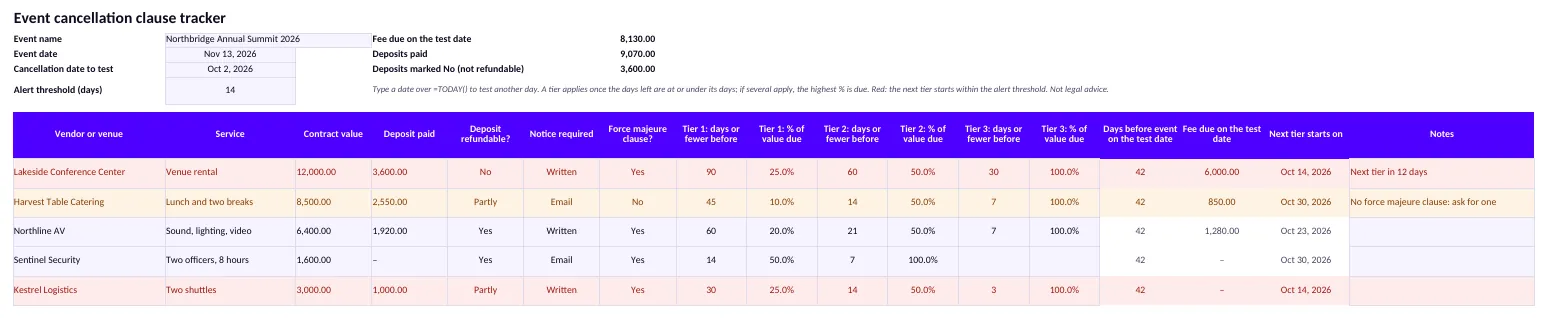
The date to watch is the day the next tier starts. In the example, at 45 days out, that day is 30 days before the event, when the fee jumps from $6,000 to $12,000. The tracker shows that day for each contract. Check the edges too: do two periods overlap, or leave a gap between them?
What the percentage is a percentage of
A Chicago chapter of Meeting Professionals International (MPI) published a worked example in June 2018, written from the hotel's side by a sales manager. A sales meeting books 100 room nights at $289, a $500 room rental and a $2,000 food and beverage minimum, for a total of $31,400. The contract carries a 90 percent cancellation clause. Canceled two months out, the company owes the hotel $28,260: the 90 percent applied to the whole program, not just the rooms.
So find the base before you compare two contracts: the total contract value, the revenue the venue expected, what is still unpaid, or the rooms only. The same 50 percent gives very different bills on each base. If the clause names none, ask for it in writing. The tracker multiplies each percentage by the Contract value column, so enter there the base your clause names.
Deposits: what you get back, and when
A deposit and a cancellation fee are two separate lines. Ask whether the deposit is refundable, in full, in part or not at all, and whether it counts toward the fee. Becker advises vendors to set their payments above the damages they could claim, so they never have to ask a canceling client for more. Read from your side, the money you have already paid may cover the fee. Then ask when a refund is paid, and in what form.
Is the fee enforceable? It depends on the state
There is no single American answer. In California, section 1671 of the Civil Code says that a contract term setting damages in advance for a breach is valid unless the party challenging it shows it was unreasonable. The test looks at the circumstances when the contract was made. A stricter rule applies to a retail purchase or rental of personal property or services, made mainly for personal, family or household purposes.
That is California's rule, and it steps aside when another statute sets its own test for the contract. Other states apply their own rules, and the contract's choice of law clause says whose apply. In a February 2020 MPI article, meetings lawyer Joshua Grimes noted that this clause states which jurisdiction's laws govern the contract. Some states and countries, he added, have statutory force majeure provisions. Read that clause before you compare fees. Whether your fee would hold is a question for a lawyer.
Force majeure: read the list and the trigger
Force majeure, in the words of PCMA's Convene magazine, essentially frees both parties when an extraordinary event beyond their control prevents one or both of them from fulfilling the contract. In an interview published in March 2022, Grimes said you can write the clause however you like, subject to agreement. So the wording decides what it covers.
Under New York law, courts read that wording closely. In a 2022 case about an art auction, a federal appeals court wrote that New York law requires courts to construe force majeure clauses narrowly. Only an event the clause specifically includes excuses a party. A catch-all phrase is read to cover things of the same kind as those listed.
The auction house had ended an agreement to sell a painting in 2020. The court found the pandemic and the governor's shutdown orders to be circumstances beyond the parties' reasonable control, of the same type as the events listed. It did not decide whether COVID-19 is a natural disaster. That is New York law.
The Venable sample on the ASAE website shows the parts to look for, though it was written for associations well before COVID-19. The PDF carries no date, and its file data say 2008 to 2009. Venable calls it a sample only, not to be relied on without a lawyer's advice. First, a list: acts of God, war, terrorism, government regulation, disaster, fire, strikes and civil disorder. It adds a curtailment of transportation facilities that prevents or unreasonably delays at least 25 percent of attendees and guests from appearing at the meeting. A catch-all covers other similar causes beyond the parties' control. It does not name disease or epidemics.
Then comes a trigger: the cause must make it inadvisable, illegal or impossible to hold the meeting. Then the outcome: the contract may end without penalty or payment, by written notice. A last sentence lets the association alone end it if, for a reason beyond its control, the facility is unavailable or not in acceptable condition. In 2022, Grimes told Convene that a clause limited to illegal or impossible was arguably harder to invoke for COVID-19. Words such as inadvisable or commercially impracticable arguably left more room.
What force majeure often leaves out
Grimes gave Convene an example: a company travel restriction is typically not force majeure. If you want it to count, put it in the contract. Attendance is another gap. In the February 2020 MPI article, he said a typical clause may not fully protect a planner from attrition charges in a health crisis. He added that such clauses usually do not foresee attendees who do not want to travel for fear of catching an illness centered in another location.
Where a clause excuses performance in part, he added, the planner may have a contractual right to reduce the event without liability. Timing is the last gap. Hotels and vendors could wait until a week or two before the event to declare force majeure, Grimes told Convene, while attendees decide months ahead. He suggests a clause that lets the group cancel or postpone when it becomes reasonably apparent that the meeting cannot go forward.
These comments date from the pandemic. In the 2022 interview, Grimes said hotels had become much more restrictive about force majeure cancellations for COVID-19. For many hotels, he said, their standard contracts would essentially not allow it. So read what your clause says today about disease and epidemics.
Postpone instead of cancel
Moving the date can cost less than canceling, if the contract allows it. In 2016, Smart Meetings quoted a planner, Ann Lohry Smith, who required her venues to let her rebook within one year, with any cancellation fee credited toward the new booking. She said it was not too hard to get, because she worked for a large national employer. In 2022, Grimes told Convene that for meetings postponed because of COVID-19, hotels were trying to treat the postponement as a cancellation by the group, not as force majeure. So write down by when you may move the date, at what cost, and whether the deposit carries over.
Ask about resale too. Many planners try to negotiate a resale credit, which lowers the fee if the hotel refills your dates. In 2016, Smart Meetings quoted Sommer Devlin saying that hotels generally resist rebooking and resale credits, because of the uncertainty and complication they create. A hotel, she says, would much prefer a lower percentage with no resale credit to a higher one it must track over time.
Attrition is a different clause
Attrition applies when the event goes ahead but you fill fewer hotel rooms than you booked. The MPI chapter example shows how it works. With 90 percent daily attrition on 50 rooms a night, the group must pay for at least 45. It fills 35, so it owes 10 rooms a night, or 20 room nights at $289: $5,780. The 2016 Smart Meetings article notes that a favorable attrition clause can let you reduce your head count at a lower cost than canceling.
The questions to ask before you sign
The Clause checklist sheet lists ten points. Mark each one present, missing or to negotiate.
- Who may cancel, and under what conditions.
- Notice: how it is sent, and which day counts.
- The fee for each period, with no overlap and no gap.
- What the percentage is a percentage of.
- Deposits: refundable or not, and counted toward the fee or not.
- Force majeure: its list, its trigger, its notice.
- Postponing: by when, at what cost, with the deposit or not.
- Attrition, for hotels: the share of the block you may drop.
- The vendor's failure: what lets you leave without a fee.
- Refund timing and form.
For a contract that commits a large share of your budget, have a lawyer read it before you sign, and again before you cancel.
Where Squena fits
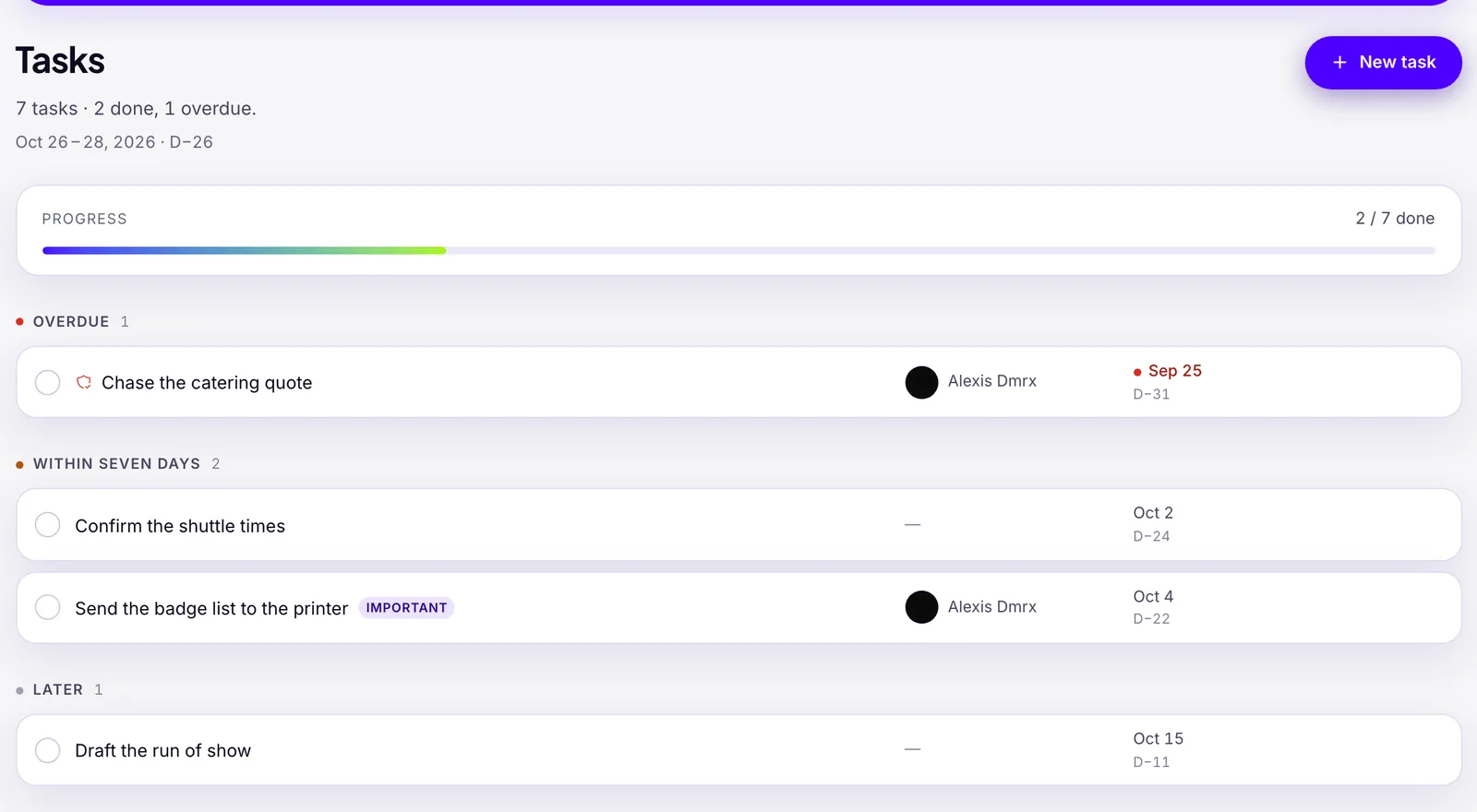
Squena keeps no fee tiers and does not work out what a cancellation would cost. The technical details of an Accommodation supplier hold one Cancellation policy choice: Free until D−30, D−15 or D−7 (D−30 is 30 days before the event), or Non-refundable. That records the headline term only. On an event, the Tasks screen lists each due date with its distance from the event's first day, grouped as Overdue, Within seven days, Later, No due date and Done. Add the day the next tier starts as a task, a few days early. Squena does not remind you when a task falls due, so check the screen.
You can also attach a contract to a question for Clara, the assistant, and ask what its clause says. She reads a PDF or an image through a third-party text-recognition service, and only its first 24,000 characters, so a long contract may be cut short. Treat her answer as a reading aid, not legal advice.
Frequently asked questions
What is an event cancellation clause?
It is the part of a venue, hotel or vendor contract that says what happens if a party calls the event off: who may cancel, how notice is given, the fee owed for each period before the event, and what happens to the deposit.
What is the difference between a cancellation clause and a force majeure clause?
A cancellation clause covers a party that chooses to end the contract, and usually sets a fee. A force majeure clause covers events outside both parties' control that the clause lists, and can end the contract without that fee. Its wording decides what counts.
Is an event cancellation fee enforceable?
It depends on the state and the contract. In California, Civil Code section 1671 treats a term that sets damages in advance as valid unless the party challenging it shows it was unreasonable when the contract was made. A stricter rule applies to consumer purchases for personal, family or household purposes. Other states apply their own rules: ask a lawyer.
Can I postpone an event instead of canceling it?
If the contract allows it, or the venue agrees. Some planners negotiate the right to rebook within a set time, with the cancellation fee credited to the new date. A hotel lawyer told Smart Meetings in 2016 that hotels generally resist such credits. Write the deadline, the cost and what happens to the deposit into the contract.
Sources
- California Civil Code, section 1671 — liquidated damages — California Legislative Information
- JN Contemporary Art LLC v. Phillips Auctioneers LLC, decided March 23, 2022 (New York law, force majeure) — United States Court of Appeals for the Second Circuit
- Model force majeure clause for association hotel contract (a sample, undated) — Venable LLP (file hosted by ASAE)
- Force majeure: negotiating a common clause in uncommon times (March 17, 2022) — PCMA, Convene
- Does your force majeure clause cover the coronavirus? (February 26, 2020) — Meeting Professionals International (MPI)
- What to know about cancellation and attrition? (June 26, 2018) — MPI Chicago Area Chapter
- Cancellation clauses and remedies (October 27, 2016) — Smart Meetings
- 'Termination' vs. 'Cancellation': crucial clauses for event planners (April 28, 2020) — Cater+Event (Informa)
- Woodstock 50 canceled by its investors (April 29, 2019) — Colorado Public Radio (from NPR)
- Judge rules Woodstock 50 is back on … for now (May 15, 2019) — CBC News (The Associated Press)