Suppliers
Event RFP template: one request for every venue, one scorecard
One workbook to send the same request to every venue and hotel, then track who answered and score each proposal.
Alexis · Co-founder of Squena · October 2, 2026 · 10 min read
In short
An event RFP is a written request you send to several venues or hotels so that each one bids on the same facts. Say what the event must achieve, give dates and a fallback, size the room block and the function space, name the contract terms you will negotiate, and state how you will score the answers. Then track who replied, and by when.
Search for an event RFP template and several kinds of pages come up. Some are for the organizer who sends a request for proposal to venues and hotels. Others cover event software or virtual-event platforms, or help an agency answer a public call, such as the ones found by searching for RFPs for event planning services. This page is written for the first reader: the organizer who sends a request to venues and hotels. The same frame also works for a destination management company or an agency you want to hire.
The point of an event RFP: every bidder answers the same questions, so you can compare answers instead of sales pitches. This guide covers what goes in the request, the contract terms to flag early, the timeline, and a scorecard you fix before the first proposal arrives. What you need from each vendor, written once, has its own guide, the scope of work template. NIGP, a US public purchasing body, says a scope of work is directed to potential suppliers, and a statement of work to the supplier once chosen. Comparing quotes line by line is covered in the vendor quote comparison template.
What goes in an event RFP
MPI, the meeting professionals association, published an article on June 15, 2026 about RFP templates. It says the opening should cover the event type, expected attendance, meeting pattern, general schedule and any high-priority business goals. A useful test for the rest of the request: each line should serve that opening.
The first job of an RFP is to explain what the event is trying to accomplish.
MPI, Event RFP template essentials to avoid hidden costs, June 15, 2026
The Events Industry Council hosts voluntary RFP forms under its APEX (Accepted Practices Exchange) program, including one for a single facility. This guide reads the older PDF. It carries no date, its file properties say 2008, and the Council lists it as "under review." The Council now also posts a 2026 edition, with the same five sections. It is a form, not a rule, and it is long. It asks for contact details and an event profile, then your requirements, how you will decide, and what each proposal must contain. The table lists the parts of a request and where each sits in the template.
| Part of the request | What it tells the venue | Where in the template |
|---|---|---|
| Overview | What the event is for, its type, expected attendance and history | RFP sheet |
| Dates | Preferred dates, alternates, how flexible you are | RFP sheet |
| Room block | Rooms by night, singles and doubles | Room block sheet |
| Function space | Each session: times, setup, attendees, F&B, AV | Function space sheet |
| Budget | The range, and what it covers | RFP sheet |
| Contract terms | What you will negotiate, and what you ask in return | RFP sheet |
| Proposal contents | What every answer must include | RFP sheet |
| Timeline | When answers are due and when you decide | RFP sheet |
| Criteria | How you will score the answers | RFP sheet and Responses sheet |
MPI says the request should outline room block expectations, general session needs, breakout counts, exhibit or sponsor space, office space, rehearsal timing and any key adjacency needs. On money, it says the request should spell out the budget range when possible. The APEX form also asks for preferred dates and three alternate sets of dates, and it has a "Concessions Desired" section for guest rooms, food and beverage and other items. The template covers the room block, the sessions and breakouts (as Function space rows), the dates with alternates, the budget range and the concessions. Exhibit space, office space and rehearsal timing have no line of their own: add each as a row in Function space, and write adjacency needs in the Function cell.
Detail matters to the people who answer. Convene, PCMA's magazine, reported on an April 2024 panel about sourcing. A hotel director of sales and marketing, from the Marriott Marquis, stressed RFPs detailed enough for hoteliers to respond more quickly. The details include catering, specs related to AV, the organization's timeline, and its history. That is one hotelier's view, in a tight market: another panelist said availability was low all over the US.
Flag the contract terms in the request
MPI says a request should not stop at operations. It should also flag the contract terms that may affect the final budget. Its list is cancellation, attrition, force majeure, payment schedule, vendor exclusivity, taxes, service fees, damage clauses and price-change language. MPI writes about the request. It does not say what those clauses should contain. The template has a line for four of them (cancellation, attrition, force majeure, payment schedule), plus one for concessions. Put the others (exclusivity, taxes, service fees, damage clauses, price changes) under What the proposal must include.
Attrition is the term to define first. The Events Industry Council, then named the Convention Industry Council, approved its Contracts Accepted Practices on December 14, 2006, and still hosts them. They define guest room attrition as the difference between the contract commitments and the actual number of sleeping rooms used, or revenue generated. An attrition clause sets how much of that shortfall the group owes. The same document adds that a contract can be binding without an attrition clause. It also says that having none does not necessarily mean no damages are owed: the obligations are then determined as a matter of law. This is a US industry document, not legal advice.
In the RFP, state your position and ask each bidder for theirs: how much attrition they accept, how it is counted, and when you must confirm your block. Write what you want to see, such as "cancellation by date, in tiers." Do not paste a clause. Our guide to the event cancellation clause covers how to read one. Ask for the draft contract with each proposal if you can. Read at least its cancellation, attrition and payment terms before you score. MPI warns that if these questions wait until the end, the attractive proposal may turn out to come with expensive terms attached. Keep the full read for the finalist.
The APEX form also reverses one question. It asks the facility what insurance requirements it has for your organization, so you learn what coverage the facility will require before you sign. That is a good line to copy into your own request, whatever your country.
Set the timeline and the criteria before you send
The older APEX single-facility form lists the dates a request should carry. The table shows them next to the template's lines. Cvent, which sells event software, gives the same advice in plain words on its blog of August 20, 2019. Tell the venue when you need the proposal returned, when you will make the initial cut, and whether a presentation will follow.
| Older APEX form | Template line |
|---|---|
| RFP published date; distribution date | RFP sent |
| Not on the form | Intent to bid due; questions due; answers sent |
| Proposal due date and time | Proposals due |
| Preliminary cut date; presentation dates | Not in the template |
| Approximate date of site inspection | Site visits |
| Decision date | Decision |
The same APEX form asks you to rate how each factor will play a role in the evaluation. It uses 1 for critical, 3 for important and 5 for minimally important. It also says that the proposal with the lowest dollar amount will not necessarily be considered the best proposal. That is the line to remember when the cheapest bid arrives.
Why publish the criteria at all? One public rule shows the logic. In US federal procurement under FAR Part 15, the solicitation must state all the factors and significant subfactors that will affect the award, and their relative importance. The agency then evaluates proposals only on the factors it specified. That rule binds federal agencies, not a private organizer. It does not tell you which weights to use. The idea carries over: decide how you will judge before you read a single proposal. Then you do not rebuild the criteria around the bid you already like.
How the template scores a proposal
The RFP sheet holds up to eight criteria, each with a weight. The example has six: location and access, room rates and block terms, function space fit, F&B and AV, contract terms, and past experience and references. The weights are 20, 20, 20, 15, 15 and 10%. These are placeholders. Change the names and the weights to fit your event.
On the Responses sheet you score each proposal from 1 to 5 on each criterion. The weighted score is a weighted average: each score times its weight, divided by the total of the weights of the criteria you scored. A venue with a blank cell is not punished with a zero, but its score rests on fewer criteria. Use 5 for the best answer. That is not the APEX scale, which rates how important a factor is, with 1 as critical. Fill every cell before you compare totals.
A score is not a decision. It sorts the proposals so you can discuss the right ones. A close pair deserves a site visit, and the line-by-line numbers are for the quote comparison template.
Track who answered
An RFP sent to eight hotels creates eight small follow-ups. The Responses sheet has one row per venue, with the contact, the date you sent the request, and the intent to bid: Yes, No or Pending. Enter the date the proposal arrived, and the On time? column compares it with the due date on the RFP sheet.
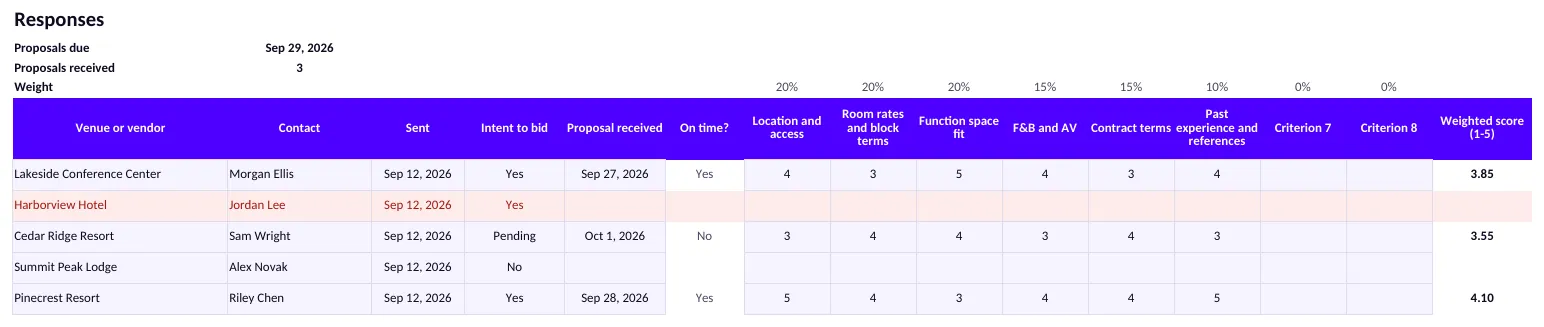
Two colors do the watching. A row turns red when the due date has passed, the venue has not declined and no proposal has arrived. A row turns amber while the intent is still Pending and no proposal has arrived, until the due date passes and red takes over. A venue marked No is not flagged. One thing the sheet does not do: a declined row does not turn red or gray, so add "declined" to the venue's name if you want it out of the way.
The APEX form carries a hard line on lateness: "Incomplete and/or late responses will not be considered." That is wording on the form, and you may keep it or soften it. Decide before the due date, not after, or the venue you like will be late and you will make an exception.
The same frame for a DMC or an agency
A glossary from Skift Meetings dated July 20, 2026 defines a DMC as a planner's destination partner. It adds that the DMC provides local expertise and manages everything from transportation and off-site events to risk management and more. The Events Industry Council also lists a separate APEX RFP form for destination management. The older PDF runs 25 pages and carries the same review notice. Venues sell space and rooms. A DMC or an agency sells a service, so some lines change.
- Keep the overview, the dates, the budget range, the timeline and the criteria as they are.
- Drop the room block and the function space, or keep them if the partner will source hotels and rooms for you.
- Replace them with the scope: what you need from the partner. That is the job of the scope of work template.
- Add references from similar events and ask who will staff your event, then score those lines too.
Where Squena fits
In Squena, a quote request starts from what you need to find on an event. The request screen, opened with New request, has up to four steps: Who to ask, What you need, Your message and Attachments. You can state the planned budget and attach files. Each supplier receives it on their own, with a link to reply. The budget and the event's name are not shared unless you choose to. When a supplier sends a quote through that link, its stage moves to Quote received, where you can Accept or Reject.
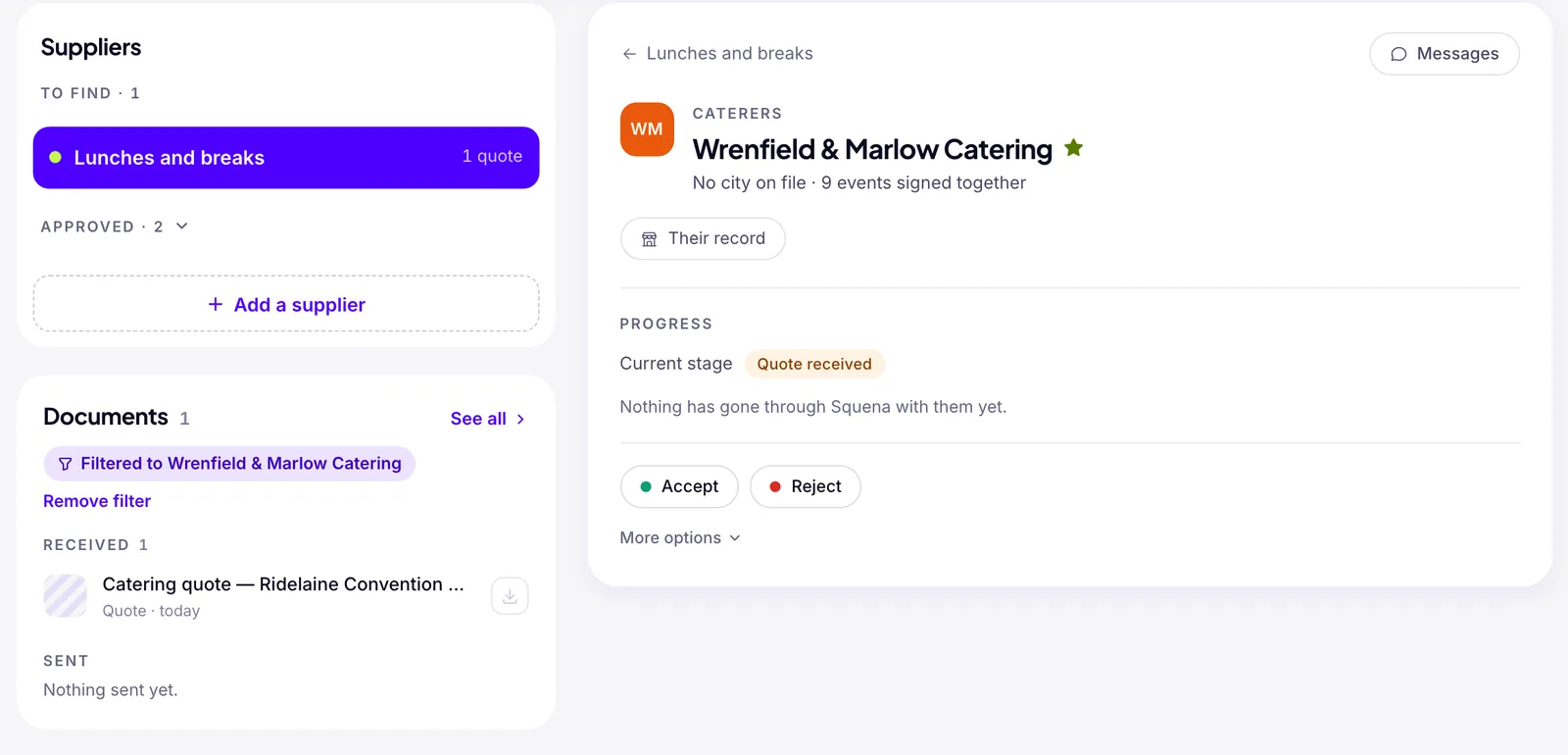
Squena is not an RFP builder. It has no room block or function space grid, no weighted scoring, and no field for intent to bid. You cannot set a proposal due date either: the reply link simply expires on its own, 14 days at most. Amounts are in euros. It does not chase a venue on its own. Keep the workbook for the request and the scorecard, and use Squena to send quote requests and keep the answers with the event.
Frequently asked questions
What should an event RFP include?
The event's purpose, type and expected attendance, preferred and alternate dates, the room block, the function space with F&B and AV, a budget range, the contract terms you will negotiate, what each proposal must contain, a timeline, and how you will score the answers.
How is an event RFP different from a scope of work?
A scope of work states what you need, and it goes to prospective vendors before they quote. An RFP wraps a process around it: deadlines, submission rules and scoring, sent to several bidders so you can compare them. Usage varies, but NIGP puts the statement of work later, with the vendor you choose.
Should an event RFP state the budget?
MPI says an RFP should spell out the budget range when possible, with any non-negotiable limits and priority spend areas. MPI's reasoning is that suppliers who must guess what the budget can support may send answers that look strong on paper but rest on expensive assumptions. Stating a range stays your call: a number can also anchor the answers.
How do I score and compare venue proposals?
Choose up to eight criteria and give each a weight before you send the RFP. Score every proposal from 1 to 5 on each criterion, with 5 as the best. Multiply each score by its weight, add them up, and divide by the total of the weights of the criteria you scored. The template does this for you. Treat the total as a way to sort proposals, then compare the finalists line by line and visit the site.
Can I use an event RFP template to hire a DMC or an agency?
Yes. Keep the overview, dates, budget range, timeline and criteria. Drop the room block and function space unless the partner will source them, and describe the scope of work you need. Add references from similar events, and score those too.
Sources
- Event RFP template essentials to avoid hidden costs (June 15, 2026) — MPI
- APEX Single Facility Event: Request for Proposal (PDF without a date, file properties 2008, marked "under review") — Events Industry Council
- APEX RFP Templates, 2026 edition (Single Facility and Destination Management) — Events Industry Council
- Events Industry Council Templates (page headed "Templates Under Review") — Events Industry Council
- APEX Contracts Accepted Practices (approved December 14, 2006, marked "under review"), attrition — Events Industry Council (then Convention Industry Council)
- APEX Destination Management Request for Proposal (marked "under review") — Events Industry Council
- Global Best Practice: Distinguishing Between Scope of Work and Statement of Work (page undated) — NIGP, the Institute for Public Procurement
- FAR 15.304, Evaluation factors and significant subfactors (federal procurement only) — Federal Acquisition Regulation (acquisition.gov)
- FAR 15.305, Proposal evaluation (federal procurement only) — Federal Acquisition Regulation (acquisition.gov)
- Is the RFP process for events getting easier or harder? (April 14, 2024) — PCMA (Convene)
- 35 popular meetings industry acronyms (July 20, 2026), DMC — Skift Meetings
- Event planning basics: writing the perfect RFP (August 20, 2019, for context) — Cvent (the company's own blog, for context)