Team
Event committee roles and responsibilities: who decides, who spends
The roles of an event committee, and the part many lists skip: how far each role can go, what it can spend, and who signs.
Alexis · Co-founder of Squena · September 30, 2026 · 9 min read
In short
An event committee usually has a chair, a treasurer, a secretary and a lead for each area: venue, vendors, program, marketing, sponsors, volunteers, guests and safety. A role list is not enough. For each role, write what it does, what it can decide alone, what it can spend up to a set limit, and who signs contracts. Give each task one accountable owner and each role a named backup.
Search for this topic and you will find plenty of role lists. Chair, treasurer, marketing lead. Most are written for fundraising galas, campus groups and workplace committees. This article is for the person who sets up a planning committee for a professional or recurring event: a company event, an association conference, an organizing committee that meets again next year. A volunteer committee can use every word of it.
The lists tell you who does what. Few say how far each role can go: what it decides alone, what it can spend, who signs. That gap is where committees stall. Two people think they can pick the caterer. Nobody thinks they can sign the quote. A member spends money nobody approved, or a vendor waits weeks for a yes.
The roles most committees need
Names vary. A chair is a convener in some groups. A treasurer is a fiscal officer in others. The jobs are the same. Here is a working set for a mid-sized event, with the decision each role holds.
| Role | Does | Decides alone |
|---|---|---|
| Chair | Convenes the committee, sets the agenda, appoints leads | Who leads each area; the casting vote, if your rules give one |
| Vice-chair | Steps in for the chair, owns a workstream | Anything the chair delegates in writing |
| Treasurer | Builds the budget, tracks spend, pays vendors | Whether a payment matches an approved line |
| Secretary | Keeps minutes, the decision log and the contact list | Nothing on spend; owns the record |
| Venue and logistics lead | Shortlists venues, plans load-in and transport | Layout and timings inside the agreed venue |
| Vendor and procurement lead | Briefs suppliers, compares quotes, negotiates | Which vendors get a brief, and the shortlist |
| Program lead | Builds the program and the speaker plan | Session order, formats and speaker invitations |
| Marketing lead | Runs the invitation, website and press | Message and channels, inside the budget line |
| Sponsorship lead | Finds and manages sponsors | Which packages to offer, within agreed rates |
| Volunteer coordinator | Recruits, briefs and schedules helpers | Who does which shift |
| Guest experience lead | Handles registration, check-in and guest questions | Registration rules and the guest journey |
| Safety and access lead | Owns the risk plan, first aid and accessibility | Whether the risk plan is complete, and when to stop an activity |
Notice the last column. It is short on purpose. If a role decides everything, the committee has one person and eleven observers. If it decides nothing, the role is a title. Write one sentence per role, and keep it about the decision, not the task.

Decision rights come before duties
Oregon State University's events guidance gives a clear example. Its event chair signs off on all funding plans in advance of any expenditure, together with the organization treasurer. The chair of its funding sub-committee also signs off, with the event chair, and creates the budget and tracks all expenditures. Sign-off is joint there. Copy the pattern: no plan goes ahead on one signature.
For charities in England and Wales, the Charity Commission asks for a similar control. Its guidance for trustees says that all charities should have financial controls that ensure more than one person is involved in receiving income and authorizing expenditure. The guidance covers any charity based in England or Wales, registered or not. In it, “should” means good practice that the Commission expects trustees to follow. A company or an association is not covered, but the habit is worth copying.
Turn that into three questions, and answer each in writing before the first meeting.
- Who can spend, and up to what limit? A treasurer might approve anything under a set amount. Above it, the chair and treasurer both agree.
- Who signs vendor and venue contracts? Pick one or two named people. A lead can negotiate and recommend. A contract that binds the event should not be signed by whoever happened to be in the room.
- Who can change the plan? Moving the date, the venue or the budget is a chair-level decision, taken with the treasurer.
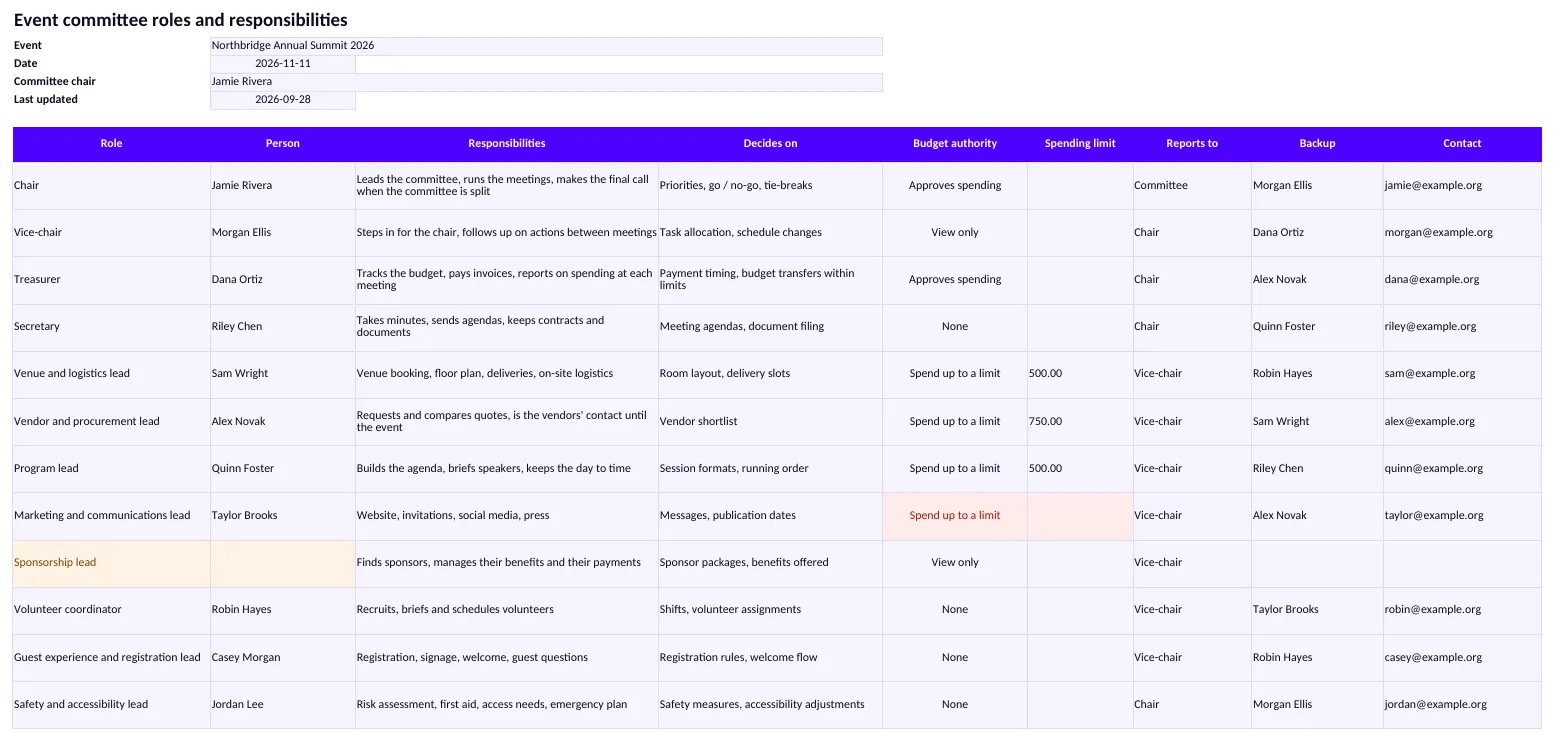
The Charity Commission adds a second point. Trustees often delegate day-to-day activities to particular trustees (such as the chair), volunteers or staff, yet they cannot delegate their overall responsibility. It asks them to set out in writing the limits of any delegated authority. That duty binds charity trustees. The habit still suits an event committee: write down how far each role can go.
For safety, the regulator is direct. In Britain, the Health and Safety Executive (HSE) says an event organizer has prime responsibility for the health and safety of its workers, the public and its contractors at the event. A committee can carry out the plan. The organization behind the event still answers for it.
One accountable owner per task
RACI is a common convention for this, not a formal standard. R is responsible: does the work. A is accountable: owns the outcome and makes the call. C is consulted before, and I is informed after. The University of Essex defines the accountable person as the one ultimately accountable for the completion of the task. It adds the rule that is the whole point: no task should have more than one role accountable.
Several people can be R on a task. Only one is A. When two people both feel accountable, each assumes the other is watching. Here is a starting chart for five key tasks. Your own committee will differ.
| Task | Chair | Vice-chair | Treasurer | Vendor lead | Program lead |
|---|---|---|---|---|---|
| Set the budget | A | C | R | C | C |
| Choose vendors | C | A | C | R | C |
| Sign contracts | A | I | C | R | C |
| Approve spending | R | C | A | C | C |
| Build the program | C | A | I | I | R |
Check the chart the way you would check a budget. Count the A's in every row. Zero means a task nobody owns. Two means a dispute waiting to happen. Then look at the columns. One person holding most of the A's is a bottleneck. A role with neither an A nor an R has no part in the plan: give it a task or drop it.
A backup for every role
Committees lose people. Someone changes jobs, falls ill or burns out halfway through. If a role has no backup, its work stops or lands on the chair. Name a backup for each role, and make sure they are copied on the same threads.
A backup is not a deputy who waits. Give them one small live duty, such as owning the vendor contact list or the volunteer schedule. Then they know the role when they need to step in. Pair roles that fit: the treasurer and the vendor lead both touch quotes, and the secretary and the guest lead both hold lists.
Two roles should not sit with one person. The chair should not also be the treasurer. It puts approval and payment in the same hands. Oregon State's guidance goes further and says it is not okay for the event chair to be the president or leader of the organization. Small committees cannot always avoid overlaps. When they cannot, write the overlap down and add a second signature on large spend.
What to update when someone joins or leaves
A committee that meets again next year rarely starts from zero. It starts from a chart that is one year old. People have left, one role has split in two, and the spending limits still assume last year's budget. Treat every change of person as a small handover, and go through this list.
- Put the name and contact details in the Person and Contact columns, and date the change in Last updated.
- Move the accountable owner of every task the old person held. Recount the A's.
- Reset the spending limit and the signing rights. A new treasurer does not inherit the last one's limit by default. Someone decides it.
- Hand over the vendor contacts, open quotes, contracts in progress and the decision log to the new person, not only to the backup.
- Tell vendors and sponsors who their contact is now, in one short message.
- Choose a new backup for the role, and for the role the backup used to cover.
Before an edition starts, run the same list on the whole committee. Ask each lead to confirm the role, the limit and the backup. It takes one short meeting, and it turns last year's chart into this year's.
Where Squena fits, and where it does not
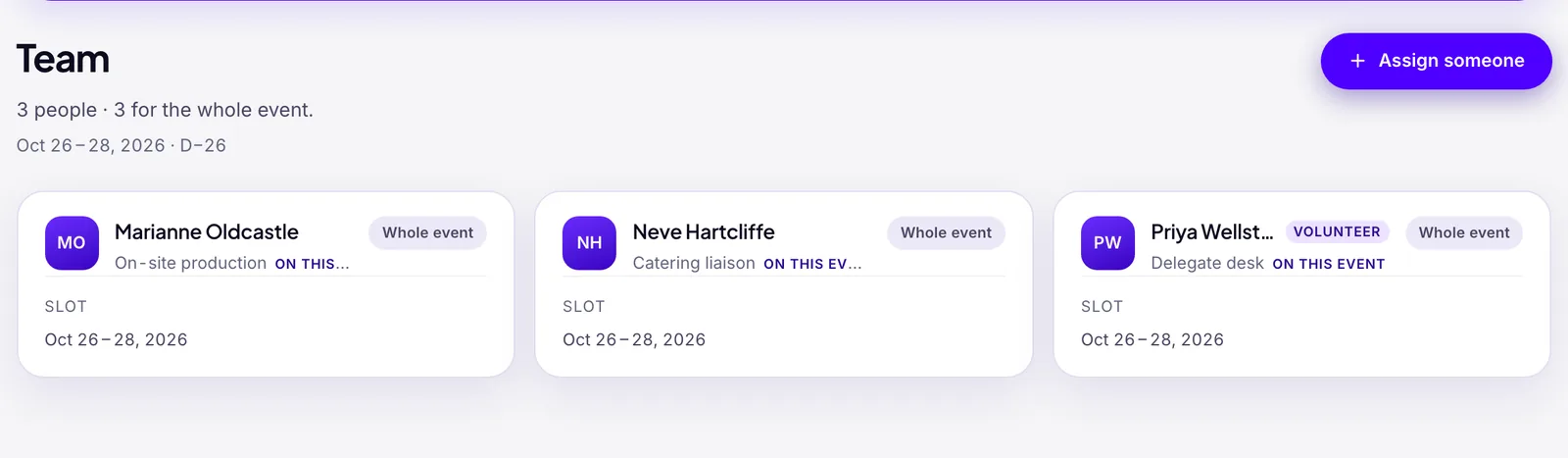
In Squena, you assign someone to an event with the Assign someone button and give them a role on this event. Leave it empty and their usual job title shows. Rights are separate for choosing a quote, signing a commitment and marking it as paid, and the volunteer role sees no amounts by default. Whoever manages the team can only grant a right they hold themselves.
There are limits. Squena has no spending limit per person, no RACI chart and no two-person approval. Those live in the template, and in your committee's habits. The workspace keeps the roles, rights and vendors of an event in one place.
Frequently asked questions
What are the main roles on an event planning committee?
Most event committees have a chair, a vice-chair, a treasurer and a secretary, plus a lead for each area: venue and logistics, vendors, program, marketing, sponsors, volunteers, guest experience, and safety and accessibility. Small events merge some of these. What matters is that each area has a named owner and a named backup.
Who should sign vendor contracts for an event?
Name one or two people in writing before the committee starts, usually the chair and the treasurer. A vendor lead can negotiate and recommend, but should not be the only person who signs. For large amounts, ask for a second signature. That keeps approval and payment from sitting with a single person.
What does RACI mean for an event committee?
RACI is a common convention for sharing work. R is responsible and does the task. A is accountable, owns the outcome and makes the call. C is consulted before, and I is informed after. Each task has exactly one A, and one or more R's. It is not a formal standard, so adapt the letters to your committee.
How do you handle a committee member who leaves mid-planning?
Treat it as a handover. Move every task they owned to a named person, recount the accountable owners, reset their spending limit and signing rights, and pass on the vendor contacts and open quotes. Tell vendors who their contact is now. The backup should step in the same week, then a new backup is named.
Does a charity event committee follow different rules?
In England and Wales, charity trustees remain collectively responsible even when they delegate. The Charity Commission's guidance says charities should have financial controls that make sure more than one person is involved in authorizing spending. Elsewhere the rules differ, so check your own regulator. A company committee can copy the same habits as good practice.
Sources
- The essential trustee: what you need to know, what you need to do (CC3) — Charity Commission for England and Wales (GOV.UK)
- Event safety: the event organizer's role — Health and Safety Executive (HSE)
- Fundraising Regulator: volunteers — Fundraising Regulator
- Sharing duties and responsibilities — Oregon State University
- Responsibility matrix — University of Essex