Production
Corporate event planning checklist: what a company event adds
A 38-task Excel checklist for seminars, parties, launches and annual meetings, with the approvals, rules and follow-up a company event needs.
Alexis · Co-founder of Squena · October 3, 2026 · 18 min read
In short
A corporate event planning checklist lists each task with an owner and a due date counted back from the event. What makes it corporate is the work around the event: budget sign-off, company rules, duty of care for employees who travel, guest data and access needs, and a report for the sponsor. Plan those rows on day one, because each one waits on someone else.
Search for a corporate event planning checklist and many pages list tasks by month or by phase. Rent for Event counts down from 12 months out, and Cvent groups its tasks by phase. This page is written for the person who plans an event for their own company, or for a client's company: a seminar, a party, a product launch or an annual meeting. A conference with many sessions has its own guide, the conference planning checklist.
What sets a company event apart is not a longer task list. It is who can say no: a sponsor, finance, legal, HR. It is also rules that already exist, and a report that someone senior reads afterward. This guide covers those parts in the order you meet them. Venue, vendors and the day itself are in the template too. They have their own guides: the event production schedule template, the run of show template and the day of event schedule template.
No form stands between you and the file: download it and fill it in. The 38 tasks and their timing are an example to adapt, not a standard. Delete, rename and re-time them. The Run it in Squena button opens the form for a new event. Squena holds your tasks and dates, not this sheet, as the last section explains.

The 38 example tasks, area by area
The table lists the 38 tasks in the file, area by area, with the range of weeks before the event for each area. The weeks are an example, not a rule.
| Area | Example tasks in the template | Weeks before |
|---|---|---|
| Budget & approvals | Confirm the purpose and how you will judge success; get the budget approved by the sponsor; agree who signs contracts and approves spending; set aside a contingency line | 24 to 20 |
| Venue | Shortlist and visit venues; sign the venue contract; confirm the floor plan and capacity | 20 to 8 |
| Vendors | Request quotes for catering, AV and decor; compare quotes and choose vendors; sign vendor contracts; confirm each vendor's arrival time and on-site contact | 16 to 1 |
| Program | Draft the agenda and the format; confirm speakers and hosts; finalize the run of show | 14 to 2 |
| Invitations & RSVPs | Build the guest list; send a save-the-date and the invitations; collect dietary and accessibility needs; follow up on missing replies; close RSVPs and share final numbers with vendors | 12 to 2 |
| Travel & lodging | Block hotel rooms for out-of-town guests; share travel and arrival instructions | 14 to 6 |
| Policies & duty of care | Check company rules on spending, gifts and alcohol; review safety and emergency plans with the venue. Brief staff on conduct and their roles; set up a way to reach guests in an emergency | 16 to 2 |
| Communications | Brief internal communications; prepare signage and printed materials; send the final practical details to guests | 10 to 1 |
| Event day | Set up and test the equipment; hold a team briefing before doors open; run registration and welcome; tear down and return rented items | 0 |
| Follow-up | Thank guests, speakers and vendors; send a satisfaction survey; hold a team debrief; pay the remaining vendor invoices; report results against the goals | 1 to 3 after |
What a company event adds to a task list
The table names six parts that depend on your company. For each one it gives the template area that holds it, who to ask first, and where the rule or guidance comes from. Where the source is your own company, no outside text can tell you what to do.
| Part | Template area | Ask first | Where the rule or guidance comes from |
|---|---|---|---|
| Approvals and budget | Budget & approvals | The sponsor, finance | Your company; MPI on budget proposals |
| Company rules | Policies & duty of care, Vendors | Procurement, legal, HR | Your company's own policy |
| Employees who travel | Travel & lodging, Policies & duty of care | HR, security, the travel manager | ISO 31030 (guidance); the law of your country |
| Access and dietary needs | Invitations & RSVPs | Legal, the venue | ADA (United States); GDPR (EU) and UK GDPR (UK), depending on where your company is based and where your guests are |
| Invitation emails | Invitations & RSVPs, Communications | Legal, marketing | CAN-SPAM Act (United States) |
| Report to the sponsor | Follow-up | The sponsor | APEX Post-Event Report (an industry form) |
Approvals, budget and company rules come first
The first two rows of the template are not about logistics. They ask you to confirm the purpose of the event and how you will judge success, then to get the budget approved by the sponsor. MPI Media, from the association Meeting Professionals International, wrote on August 31, 2026 about why budgets get cut. Its answer is below. It is an editorial view, not a study.
The budget proposal that gets cut is usually the one that just lists expenses. Meanwhile, the one that gets approved connects these expenses to outcomes that the business wants to achieve.
MPI Media, Using event industry statistics to support your next budget proposal, August 31, 2026
What you draw from it: ask the sponsor, in the first meeting, what result would make the event worth its cost. Write the answer in the first row. It becomes the last row too, the report you owe afterward.
A large company may also run a program for this. The Global Business Travel Association (GBTA) calls strategic meetings management “a discipline focused on managing enterprise-wide meeting and event processes” in the outline of its course. The same outline mentions preferred supplier programs for hotels, technology and travel. Ask in week one whether your company has such a program. If it does, it may decide which hotels and vendors you can use before you request a single quote.
Two more rows are yours to settle with the company: who signs contracts and approves spending, and what the rules say about spending, gifts and alcohol. No outside standard writes those for you. Ask for the policy in writing, because it can change the venue, the menu or the guest list. The numbers themselves, such as committed spend and the contingency line, are in our guide to the event budget template.
Duty of care for the employees who travel
Duty of care is what an organization owes the people it sends somewhere for work. ISO 31030:2021 is titled Travel risk management, Guidance for organizations. A 2021 guide to its British edition, an executive briefing by Bob Quick of Global Secure Accreditation, says it is guidance rather than a specification and cannot be used for certification. The briefing says it is not peer-reviewed and may be a sponsored publication. Its views are the authors', not necessarily BSI's. The guide defines duty of care this way:
moral responsibility or legal obligation of the organization to protect the traveller from threats and risks
A guide to BS ISO 31030:2021, travel risk management, by Bob Quick (Global Secure Accreditation)
The guide says it explains what the standard means for any organization that requires its staff to travel on its behalf. It adds that business travelers include anyone “travelling at the request of, or on behalf of the organization,” and it gives subcontractors as an example. Guests from outside the company, such as customers, are a gray area. Ask your legal team.
The passage the guide quotes says “preferred” or “approved” accommodation has traditionally focused on room types, rates, cancellation policies and range of services. It fits the row Block hotel rooms for out-of-town guests. If an organization uses such terms, it says they should be “inclusive of health, safety and security considerations” too.
GBTA's site shows an article on the five pillars of travel risk management dated July 20, 2022. Its examples date from 2017. The pillars it lists: a policy, safety information, limits on high-risk travel, knowing where your people are, and a crisis plan. For the fourth, it says you “must be able to reach out to your travelers to ensure their safety and offer support” after a safety, security or health incident. That is the idea behind the rows Review safety and emergency plans with the venue and Set up a way to reach guests in an emergency. Neither text is law. What your company owes depends on the country, and on whether the person is an employee, a contractor or a customer. Ask legal what applies.
Access needs, dietary needs and guest data
This section covers rules in the United States, the European Union and the United Kingdom. It is not legal advice: ask a lawyer which rules apply to your company, your guests and your venue.
In the United States, the Americans with Disabilities Act (ADA) shapes how a company treats its own staff at its own events. ADA.gov says Title I applies to employers that have 15 or more employees. Its list of covered areas includes “social activities” as well as hiring, promotions and pay. EEOC guidance dated October 17, 2002 was issued before the 2008 ADA amendments. It names employer-sponsored “parties or other social functions (e.g., parties to celebrate retirements and birthdays, and company outings)” among the benefits of employment. It says an employer must provide a reasonable accommodation so that an employee who needs one can take part, unless it can show undue hardship. Its disclaimer says the contents “do not have the force and effect of law,” so read it as the agency's reading of the statute, not as the statute.
Guests who are not employees raise a different question. ADA.gov says Title III applies to businesses and nonprofits serving the public, with hotels and restaurants among its examples, so your venue may be covered. Whether your own company is covered for an event it hosts depends on what it is and does, and that is a question for counsel.
For your own staff, the EEOC's training example holds two ideas. An employer may want to specify in the contract who provides accommodations. It should also make sure offsite training is held in an accessible facility when an employee needs one. The EEOC wrote this about training, not parties. In its example, the employer still had to provide the accommodation when the trainer refused, absent undue hardship, so a contract helps but does not move your own duty. What you draw from it: ask the venue and the caterer to say in the contract who provides what.
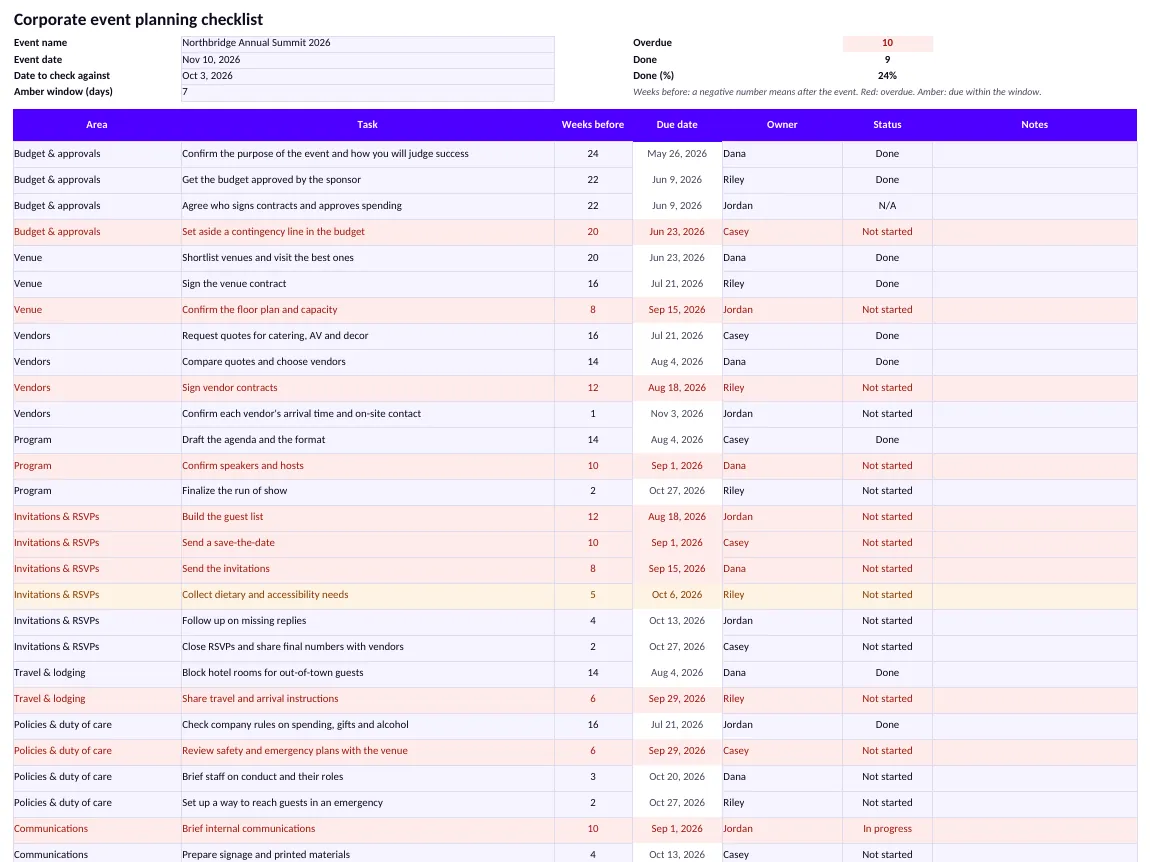
The Mid-Atlantic ADA Center, one of ten regional ADA Centers of the ADA National Network, publishes a guide to accessible meetings, in a 2015 digital edition. It says forms should “ask specifically about your audience’s needs and accommodations” and collect dietary needs “during the registration process,” which matches the row Collect dietary and accessibility needs. In the preview below, it is the amber row.
The answers to those questions can be sensitive data in the EU and the UK. The European Commission lists “data concerning health” and “data revealing religious or philosophical beliefs” among the categories that carry specific processing conditions. The UK regulator, the ICO, says health data covers “any information on injury, disease, disability or disease risk,” and any related data that reveals the state of someone's health. An access need or an allergy can fall under that. The Commission adds that a company can process these categories only if a listed condition is met, such as the individual's explicit consent.
Who is covered? The Commission says the GDPR applies to a company or entity that processes personal data as part of the activities of one of its branches established in the EU. It also applies to one outside the EU that is “offering goods/services (paid or for free) or is monitoring the behaviour of individuals in the EU,” in its words. Whether a company outside the EU is caught when it invites a European client to an event is a question for counsel. What you draw from it: ask for what the caterer or the venue must act on, not for the reason. Say who will see the answers, and keep them off the shared guest list.
Invitation emails: when the CAN-SPAM Act applies
In the United States, a federal law sets the rules for commercial email: the CAN-SPAM Act. The FTC's compliance guide, dated August 2023 and edited in January 2024, covers any message whose “primary purpose” is to advertise or promote a commercial product or service. It says the law “makes no exception for business-to-business email.” A commercial message must carry a postal address and a way to opt out. The sender must honor an opt-out request within 10 business days.
The guide does not mention event invitations. Whether one is commercial turns on its primary purpose, and the guide says the law reads the categories of transactional or relationship messages narrowly. An invitation to customers that promotes your product may count. If in doubt, treat it as commercial and check the details with counsel.
After the event: a report the sponsor can read
A company event answers to someone afterward. The Events Industry Council (EIC) publishes a Post-Event Report template under its APEX program. Its 2026 edition sits on a page dated June 23, 2026. It keeps the nine sections that the Convention Industry Council approved in 2003 and updated in 2005. It adds four more, including accessibility outcomes and a cybersecurity and data incident protocol. Read it as an industry form, not a rule. Its list of event types includes board meeting, customer event, local employee gathering, product launch, sales meeting, shareholders meeting, team-building event and training meeting.
The 2026 guidance says to complete the report within 30 days of event close, where the 2003 and 2005 text said 60 days. It adds that the final report goes to all stakeholders within 14 days of completion. The edition keeps the older instructions verbatim. They include meeting each venue right after the event and attaching the latest report to any request for proposals for a future edition. The form has a field for event objectives. It is built around hotels and venues, with room blocks and function space. In the template's example, the report is due three weeks after the event, inside the 30 days.
What do planners measure? MPI's Meetings Outlook for the second quarter of 2026 drew 163 responses between March 18 and April 1. In it, 80% of respondents report using post-attendee surveys to measure the human impact of events, which MPI also words as the impact on people. And 47% named low attendee response rates as a challenge in measuring that impact. MPI notes that the Outlook is supported in partnership with IMEX Group.
It’s not enough to just produce a well-run event, there’s more pressure to show what actually changed because of it.
Michael Farrell, CTA, director of development at Van Wagner, survey response in MPI's Meetings Outlook, Q2 2026
What you draw from it: pick the measure with the sponsor before the event, in the first row of the template, so the last row has something to report against. Then send the survey while guests still remember the day.
Set the weeks yourself, then read the colors
The weeks in the file are an example. They run from 24 weeks before the event to 3 weeks after, and no number there is a rule. Set yours by working back from the items that wait on someone else: the sponsor's approval, the venue contract, the guests' travel. Give the other tasks the time between.
Once you enter the event date, each due date is the event date minus seven days for every week. A row turns red when the due date has passed and the status is not Done or N/A. It turns amber inside the window you set, 7 days by default. A row marked Done or N/A turns neither red nor amber. Mark a task N/A when it does not apply to your event, and the counters leave it out.
The By area sheet is the one to show the sponsor. For each of the ten areas it gives the number of tasks, how many are done, how many are overdue and the share done. An Other row counts tasks whose area you typed yourself, and a Total row sums them up. An area turns red when it has an overdue task. If Policies & duty of care still shows 0% the week before the event, you know where to look.
Where Squena fits
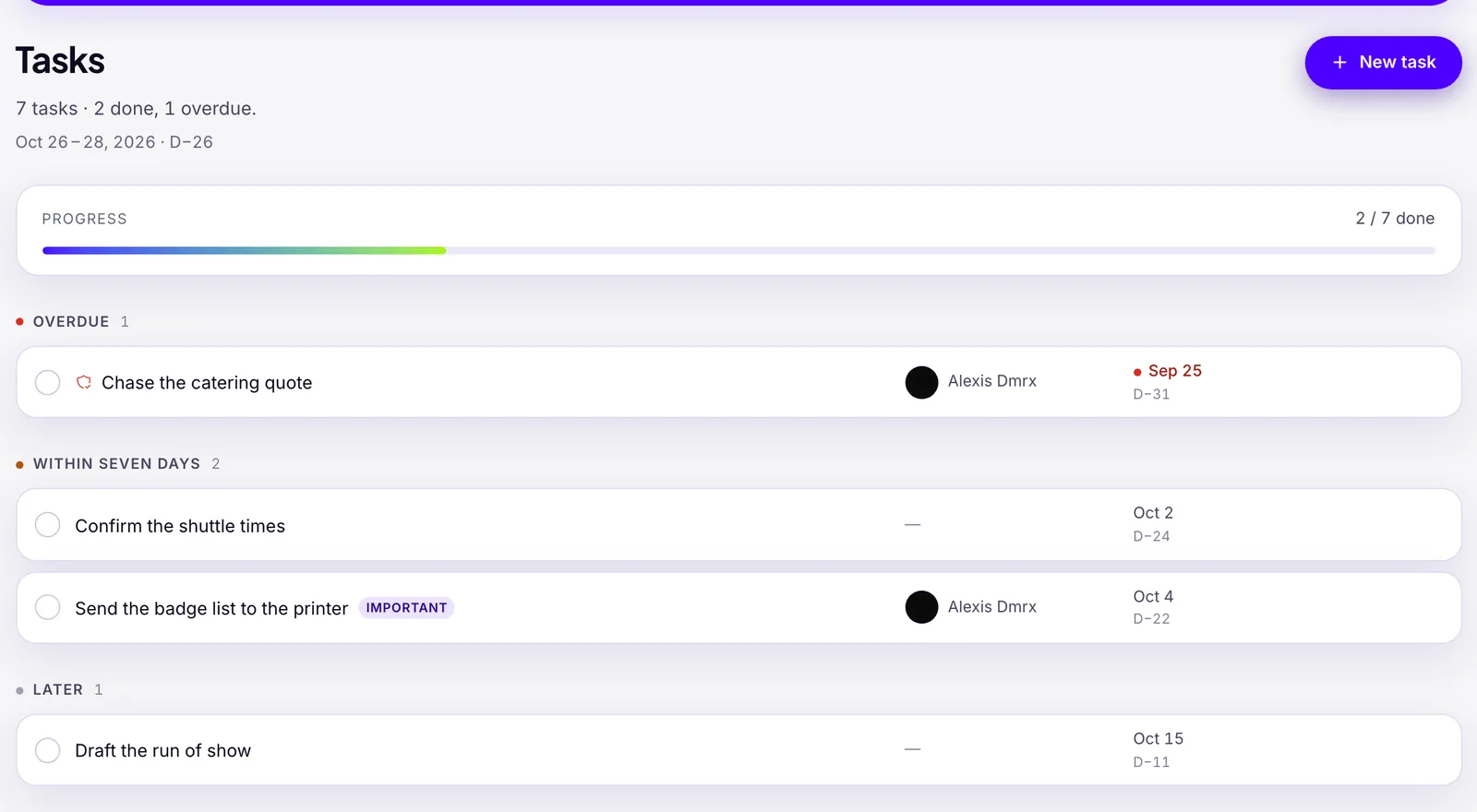
In Squena, an event has a Tasks screen. A task has a title, notes, a status (To do, In progress, Blocked or Done), a priority (Normal, Important or Critical), a due date and a person it is assigned to. The screen groups tasks as Overdue, Within seven days, Later, No due date and Done. Each due date shows as a count from the event's first day: D−31 is 31 days before it. A task ticked off after its due date leaves Overdue.
Squena is not a checklist template. A new event starts with no tasks, and there is no weeks-before column, no N/A status and no area field. The seven-day window cannot be changed. Squena does not calculate due dates from the event date: you type each one. Clara, Squena's assistant, can also add a task, and her Make it a task button proposes a date three days out, or the day before the event if that comes first. An event holds 300 tasks at most, counting those in Recently deleted. Squena holds no guest list, event invitations or RSVPs either. Keep the workbook for the structure, and use Squena to give each task an owner and a date the team sees.
Frequently asked questions
What should a corporate event planning checklist include?
Beyond venue, vendors, program and day-of tasks, a corporate checklist needs rows for the sponsor's budget approval and for who signs contracts. It also needs company rules on spending and alcohol, duty of care for employees who travel, dietary and access needs, invitation emails, and a report against the goals. The template has 38 example tasks in ten areas.
How far ahead should I start planning a corporate event?
No single lead time fits every company event. The template's example runs from 24 weeks before the event to 3 weeks after. Your own timing depends on the items that wait on others: the sponsor's approval, the venue contract and guests' travel. Work back from those, and change the weeks column to match.
What is duty of care at a corporate event?
Duty of care is the “moral responsibility or legal obligation of the organization to protect the traveller from threats and risks,” in the words of a guide to ISO 31030. ISO 31030 is guidance, not law. What your company owes depends on the country, and on whether the person is an employee, a contractor or a customer, so ask your legal team.
Do I have to ask guests about dietary and access needs?
None of the sources cited here requires you to ask every guest. In the United States, ADA.gov says Title I covers employers with 15 or more employees. The EEOC says such an employer must accommodate an employee who needs it to join a company party, unless that is an undue hardship. The Mid-Atlantic ADA Center advises asking on the registration form. In the EU and UK, health answers can be sensitive data, so ask only what you will act on.
Can I get the corporate event planning checklist as a PDF?
The download is an Excel file (.xlsx), free and without sign-up. Excel can save a sheet as a PDF. Enter the event date first, so the due dates appear, then save the Checklist sheet when it shows the dates you want to print.
Sources
- Introduction to the Americans with Disabilities Act (Title I: employers with 15 or more employees; Title III: businesses serving the public) — ADA.gov (US Department of Justice)
- Enforcement Guidance on Reasonable Accommodation and Undue Hardship under the ADA (issued October 17, 2002; not law) — US Equal Employment Opportunity Commission
- CAN-SPAM Act: A Compliance Guide for Business (August 2023, edited January 2024) — US Federal Trade Commission
- Application of the GDPR: who the data protection law applies to — European Commission
- Legal grounds for processing data: under what conditions can a company/organisation process sensitive data? — European Commission
- What is special category data? (UK GDPR) — Information Commissioner's Office (UK)
- Accessible Meetings, Events & Conferences Guide (2015 digital edition of a 1993 guide) — Mid-Atlantic ADA Center and TransCen, Inc. (ADA National Network)
- A guide to BS ISO 31030:2021, Travel risk management: Guidance for organizations (2021 executive briefing by Bob Quick; its disclaimer says it is not peer-reviewed and may be a sponsored publication) — Global Secure Accreditation (executive briefing, copyright The British Standards Institution)
- The Five Pillars of Travel Risk Management (July 20, 2022; examples from 2017) — Global Business Travel Association (GBTA)
- Strategic Meetings Management course outline (undated) — Global Business Travel Association (GBTA)
- Using event industry statistics to support your next budget proposal (August 31, 2026) — MPI Media (Meeting Professionals International)
- Meetings Outlook, Q2 2026 (163 responses, March 18 to April 1, 2026) — MPI (Meeting Professionals International)
- APEX Post-Event Report, 2026 edition (page dated June 23, 2026; keeps the 2003 and 2005 instructions) — Events Industry Council
- APEX Post-Event Report Template, 2026 edition (PDF preview with the 30-day and 14-day guidance) — Events Industry Council
- Corporate event planning checklist (a competitor's page, counted by months before the event, for context) — Rent for Event (a venue's blog, for context)
- Create the ultimate event planning checklist (a competitor's page, grouped by phase, for context) — Cvent (the company's own blog, for context)