Team
Event call sheet template: who is where, and when
The sheet for the day before: where each person reports, at what time, and who to call.
Alexis · Co-founder of Squena · October 1, 2026 · 9 min read
In short
An event call sheet is the sheet you send the day before to every crew member, volunteer and vendor team. It gives each person a call time, a place to report, a phone number to call and the emergency basics: nearest hospital, first aid point and who is in charge on site. A film call sheet follows one shoot. A live event call sheet follows many companies, one venue and an audience that arrives on a fixed hour.
The call sheet comes from film and TV. This page adapts it to live events, such as conferences, festivals and trade shows. The reader is the organizer or production lead who has to get a crew and several vendor teams through one door at the right time.
Stagetimer defines a call sheet for events as a document sent out by a production manager to tell speakers exactly where they need to be for a day of an event. It lists the show and date, the place, the arrival time, the key contacts, the nearest hospital and an emergency number. Rentman, a crew-planning tool, describes a crew call sheet in similar terms, with call times, parking and dress code. Both are vendors describing their own templates (pages read on October 1, 2026). They show what readers expect to find.
No form stands between you and the file: download it and fill it in. Delete the rows you do not use before you send it. The “Run it in Squena” button opens the form for a new event. Squena holds your team and its dates, not this sheet (see the last section).

What goes on a live event call sheet
Each person needs to read only their own line: a time, a place, a phone number. Everything above the crew table is shared by all. Everything below it is for the day it goes wrong.
| Block | What to write | What it spares you |
|---|---|---|
| Event and venue | Name, date, address, crew entrance, parking | A crew sent to the guest entrance |
| Key times | Load-in, doors, start, curfew, load-out | Everyone guessing the day's hard edges |
| Crew table | Name, role, company, call time, report-to place, phone, wrap | Forty people asking the lead where to go |
| On-site contacts | Lead, venue contact, security, first aider | Calling the office for a phone number |
| Safety basics | Nearest hospital, first aid point, emergency number | Looking for them during an incident |
| Weather, dress, meals | A forecast note, what to wear, when and where crew eat | Wet, cold or hungry people at 4 p.m. |
A call time is the hour a person must be at a given place, ready to work. It is not the hour the show starts, and not the hour the person leaves home. Give each person a call time and a report-to place, such as the loading dock or the production office. Add an estimated wrap time so people can plan their trip home.
The day-of schedule gives the whole day to the organizer. The run of show gives the program cue by cue. The call sheet is neither: it is the page each person receives, cut to their own call.
What changes between a film shoot and a live event
A film call sheet follows one production, in one place, for a day of shooting. A live event brings several companies into the same building, and then lets in an audience. What follows is a reading of the difference, not a rule.
| Film or TV shoot | Live event | |
|---|---|---|
| Who it covers | On a shoot, typically the cast and crew of one production | Staff, volunteers and teams from several vendors |
| Hard edge | On a location shoot, typically the light and the permit | Doors at a fixed hour, venue curfew |
| Who else is there | Mostly the production | A paying or invited audience |
| Access | One place to report | Dock, crew door, guest entrance, parking |
The practical result is that a vendor's lead needs the sheet for its own people. Do not rewrite it for them: send each vendor its own lines plus the shared header, and let the vendor give its people their own call times. Ask for the vendor's lead name and mobile number in return. For a multi-day event, make one sheet per day. Stagetimer says you need separate call sheets for each day of your event, so the date matters.
The emergency block
Great Britain's Health and Safety Executive tells organizers of all but the smallest events with low risks to draw up and discuss their plans with the emergency services. It says that you, as the organizer, and the emergency services should be clear about who will do what if there is an emergency or major incident. It also asks you to brief staff. Its words: make sure that all relevant staff members, whatever their normal role, understand what they should do in an emergency. Its examples include the exits and who to take instructions from. The call sheet cannot do that alone. It can carry the facts a briefing points to: the first aid point, the hospital and the name of the person in charge.
HSE adds that, in Great Britain, the organizer has prime responsibility for the health and safety of its workers, the public and the contractors working for it at the event. A call sheet does not discharge that duty. It helps by putting one name and one number where everyone can find them.
In the United States, the Occupational Safety and Health Administration has its own rule. An employer covered by OSHA must have an emergency action plan whenever a standard in OSHA's general industry rules (29 CFR 1910) requires one. The plan must be in writing, though an employer with 10 or fewer employees may share it orally. It includes how to report an emergency, evacuation routes and a contact for questions. That is a separate document. Whether a given event needs one depends on the standards that apply to you. OSHA's evacuation plans page is the place to check. Your call sheet can then point to the plan.
For outdoor events, add a weather note. The National Weather Service tells groups to have a lightning safety plan and to be ready to use it. It warns that a large group needs extra time to reach a safe place. Its page, written for people outdoors, says to wait 30 minutes after the last rumble of thunder before resuming play. The sheet can name who watches the forecast and where people go. FEMA's Emergency Management Institute lists a four-hour web-based course, IS-15.B, Special Events Contingency Planning for Public Safety Agencies. Its page says it covers pre-event planning, forming the planning team, event hazard analysis and responding to incidents. It is written for public safety personnel, so it shows the view from the other side of your event.
Hours on site, and what the red row means
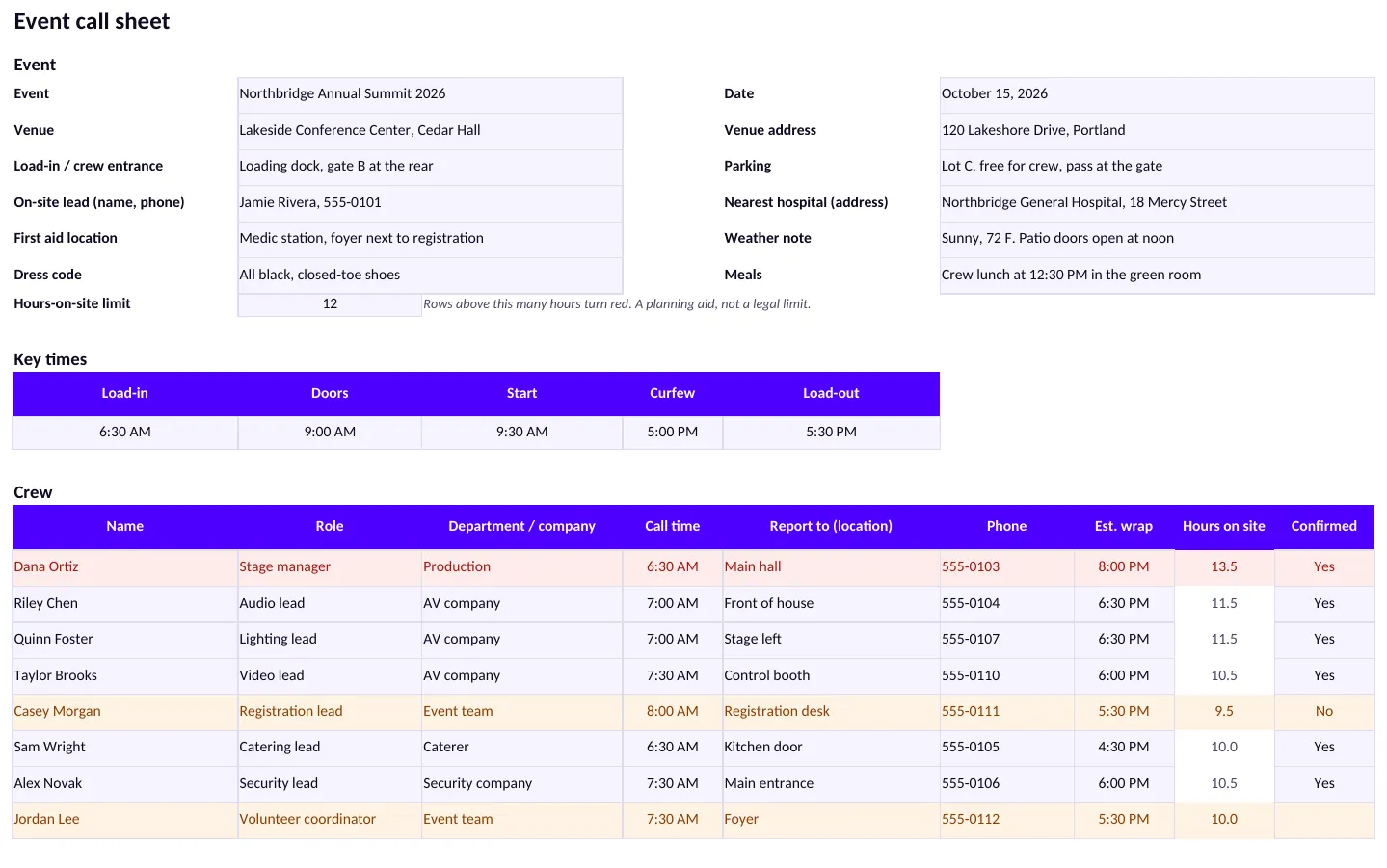
The crew table calculates hours on site from each call time and estimated wrap. A row turns red when the result passes a limit you set, 12 hours by default. That figure is a prompt to look at the row, not a legal rule. Change it to suit your team and your venue.
The law depends on who works and where. In the United States, the Department of Labor says the Fair Labor Standards Act sets no limit on hours per day or per week. That holds for employees aged 16 and older. It does require overtime pay after 40 hours in a workweek, for covered employees who are not exempt. State rules can differ.
In Great Britain, workers have the right to 11 hours rest between working days. GOV.UK says this applies to workers over 18, with exceptions for some kinds of work. Northern Ireland has its own regulations. There is also a weekly cap: you cannot work more than 48 hours a week on average, normally averaged over 17 weeks, unless you opt out. Check which rule covers your crew and your country before you rely on any number. The template makes the long days visible. The law is for you or your lawyer to read.
Send it the day before
Send the sheet the day before, once the day-of schedule is stable. The template has no version field: add a version number and a last-updated time to the file name. Rentman puts the goal in one sentence: everyone knows where to be, when to arrive, and who to contact if something changes. That sentence is the test of your sheet.
- Crew and volunteers: the shared header and their own line.
- Vendor leads: their company's lines, plus the on-site contacts.
- Venue contact: the full sheet, so the venue knows who is coming through its doors.
Ask for a reply. Mark Confirmed only after a reply, and leave the others amber. The rows still amber the evening before are the people to call first. If the sheet changes, reissue it and say what changed.
Where Squena fits
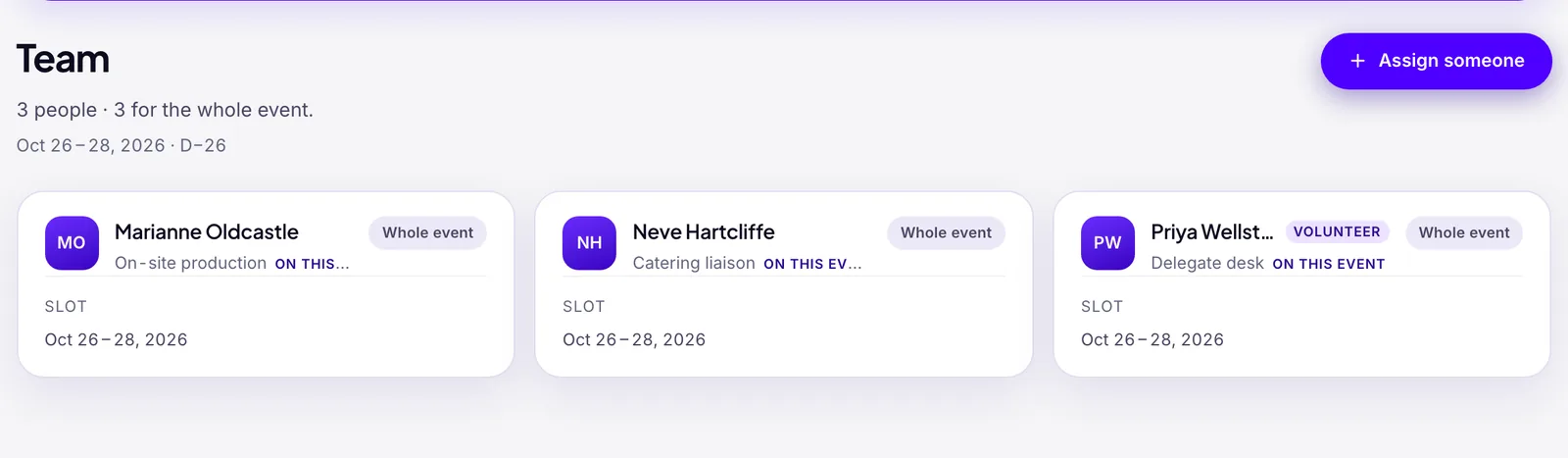
Squena holds the team of an event. A person is assigned to it with an optional role, and is marked “Whole event” unless you give them a “Slot”, with a start and an end date. Each card shows its dates under “Slot”; “Whole event” means they are the event's own dates. The help text on the screen says a slot may run outside the event, for example for a stage manager on a recce the day before. Click a person's card to open their panel, where you can change the role and the slot and copy their email address.
The limit is plain: Squena counts slots in days, not hours. It holds no call time, no report-to place and no hours on site, and it does not send a call sheet. Keep the sheet in your spreadsheet. Use Squena to know who is on the event, in which role and on which dates.
Frequently asked questions
What is an event call sheet?
It is a sheet sent to the crew, volunteers and vendor teams before an event day. It lists each person's call time, where to report, who to call and the emergency basics, such as the nearest hospital and the first aid point. The idea comes from film and TV production.
When should you send a live event call sheet?
Send it the day before, once the day-of schedule is stable. Ask for a reply from each person and mark them confirmed only after you hear back. Reissue the sheet with a new version number whenever a time or a place changes, and say what changed.
What is the difference between a call sheet and a run of show?
A call sheet tells each person where to be and when, with a phone number to call. A run of show is the program of the event, cue by cue. A day-of schedule sits between them, with the logistics of the whole day for the organizer.
What is a call time?
A call time is the hour a person must be at a given place, ready to work. It is earlier than the hour of the show and different for each role. A crew member who builds the stage has a different call time from the person at the guest desk.
Is there a legal limit on how many hours crew can work?
It depends on the country and the worker. In the US, the Fair Labor Standards Act sets no daily or weekly cap on the hours that employees aged 16 and older can be required to work. It does require overtime pay after 40 hours a week for covered employees who are not exempt. In Great Britain, workers over 18 have the right to 11 hours of rest between working days, and a limit of 48 hours a week on average unless they opt out. Both have exceptions. Check your own rules.
Sources
- Incidents and emergencies — who does what, and briefing staff — Health and Safety Executive (Great Britain)
- Event safety: roles — the organizer's prime responsibility — Health and Safety Executive (Great Britain)
- Lightning safety when a safe building or vehicle is nearby — National Weather Service (US)
- 29 CFR 1910.38 — emergency action plans — OSHA (US Department of Labor)
- Fair Labor Standards Act — frequently asked questions on hours of work — Wage and Hour Division, US Department of Labor
- Rest breaks at work — 11 hours rest between working days — GOV.UK
- Maximum weekly working hours — the 48-hour limit — GOV.UK
- Emergency action plans — where to check when one is required — OSHA (US Department of Labor)
- IS-15.B, Special Events Contingency Planning for Public Safety Agencies (course dated October 31, 2013) — FEMA Emergency Management Institute (US)
- What is a call sheet? (read on October 1, 2026) — Stagetimer (for context)
- Crew call sheet template (read on October 1, 2026) — Rentman (for context)